Skip to content
Modern Physics · Physics

Alpha Decay & Half-life Simulation

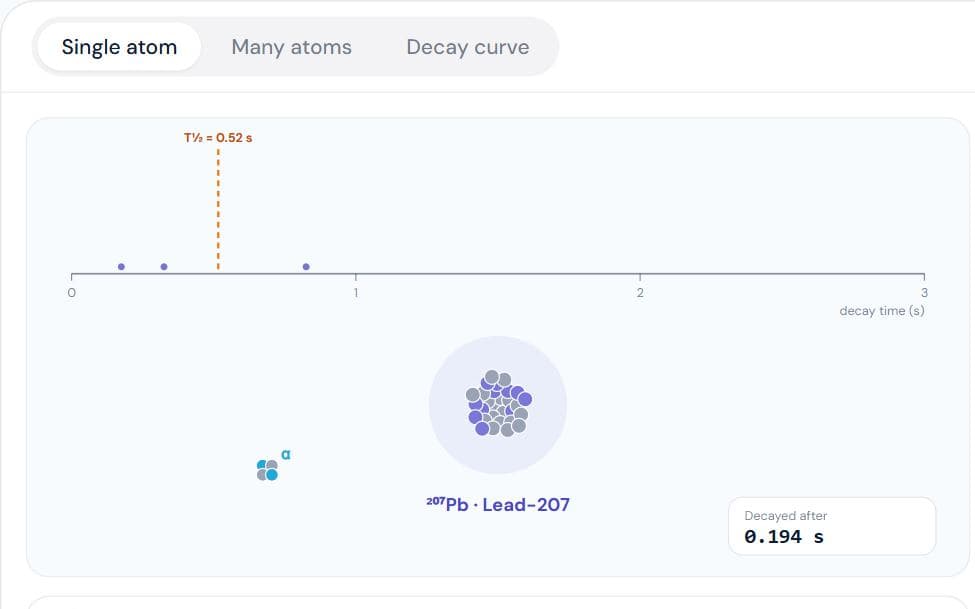
Watch single nuclei of polonium-211 decay at random, then hundreds at once, and see the random events add up to N = N₀ e^(−λt).

Interactive virtual lab · no download · works on phones and laptops

Chapter
Nuclei
For
Class 12 · JEE · NEET
Time
~15 min

Alpha Decay & Half-life is a Pro simulation

Pro opens all 125 virtual labs — 483 simulations with guides and quizzes.

How to use it

  1. 1Single atom: add a nucleus and record when it decays. Repeat.
  2. 2Many atoms: add 1, 10 or 100 nuclei and watch the counts.
  3. 3Decay curve: start a batch and compare it with the theory curve.
  4. 4Choose a custom half-life to see how λ changes the curve.

What to notice

  • You cannot predict when one nucleus will decay — only the odds.
  • Each half-life, about half of whatever remains decays.
  • More atoms → the measured curve hugs the exponential more closely.
  • ²¹¹₈₄Po → ²⁰⁷₈₂Pb + ⁴₂He: mass number falls by 4, atomic number by 2.

For teachers

A ready-made teaching kit comes with this lab

  • Lesson plan

    22 min, 4 steps

  • Ask the class

    3 questions with answers

  • Quick quiz

    6 questions, printable

  • Key formulas

    4 formulas

About the Alpha Decay & Half-life simulation

Radioactive decay is random: you cannot tell when a single nucleus will decay, only the chance per second. With many nuclei that chance gives a smooth exponential curve, and the time for half of them to decay — the half-life — is always the same. In alpha decay a nucleus throws out a helium nucleus, losing 2 protons and 2 neutrons.

In this alpha decay simulation you watch a single polonium-211 nucleus wait an unpredictable time before it decays, then add hundreds of nuclei and see the decay curve follow N₀e^(−λt). Change the half-life, record decay times, and compare your measured mean life with T½/ln 2. It covers Nuclei in Class 12, JEE and NEET.

Also covers: radioactivity, half life, polonium, nuclear decay.
Frequently asked questions

What fraction of a sample remains after three half-lives?

One-eighth: ½ × ½ × ½.

Can we predict when one nucleus will decay?

No. Decay is random; only the probability per unit time (λ) is fixed.

What is the relation between half-life and mean life?

τ = T½ / ln 2 ≈ 1.44 T½.