Skip to content
Modern Physics · Physics

Double-Slit Experiment Simulation: Waves & Particles

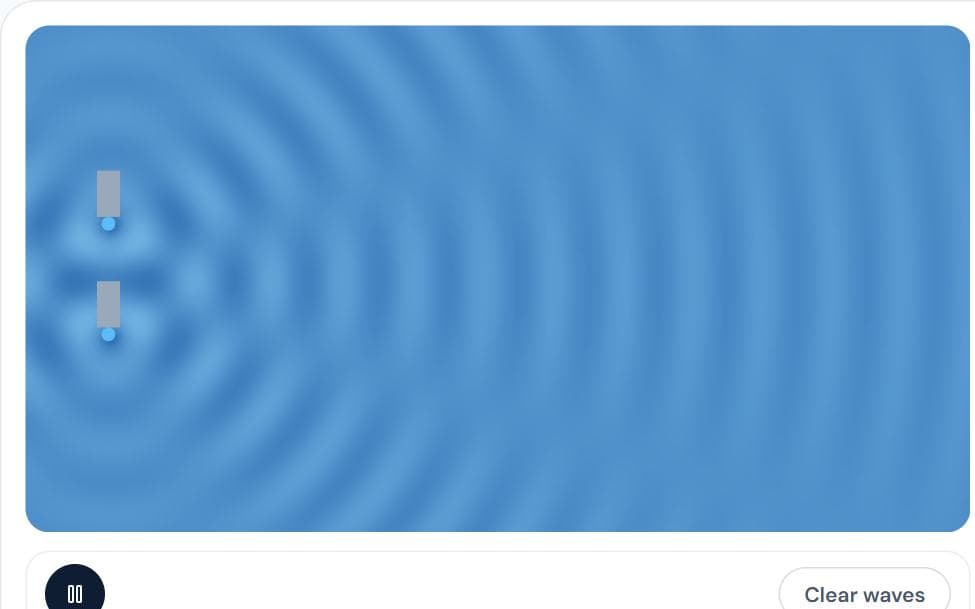
Fire photons or electrons at two slits one at a time. Each lands as a single dot — yet the dots build an interference pattern. Turn on a which-slit detector and the fringes vanish.

Interactive virtual lab · no download · works on phones and laptops

Chapter
Dual Nature of Radiation and Matter
For
Class 12 · JEE
Time
~12 min

How to use it

  1. 1Choose a source and set its wavelength or speed.
  2. 2Fire one at a time, a stream, or switch to high intensity.
  3. 3Change slit separation and width; watch the pattern.
  4. 4Turn on the detector at one slit.

What to notice

  • Every particle is detected at one point, but where it lands follows the wave's |ψ|².
  • Fringe spacing is λD/d: longer wavelength or closer slits give wider fringes.
  • For electrons λ = h/(mv): faster electrons give narrower fringes.
  • Knowing which slit each particle used destroys the interference.

For teachers

Teach it in 20 minutes

A lesson plan, questions to put to the class, a quick quiz you can project or print, and the formulas behind Double-Slit: Waves & Particles.

  1. 1Hook

    ~2 min
    • Fire electrons one at a time and ask: “Each one lands as a single dot. Will a pattern ever appear?” Let it run for a minute in silence.
  2. 2Demonstrate

    ~7 min
    • Choose a source and set its wavelength or speed.
    • Fire one at a time, a stream, or switch to high intensity.
    • Change slit separation and width; watch the pattern.
    • Turn on the detector at one slit.
  3. 3Pause and ask

    ~5 min
    • Have a student say this in their own words: Every particle is detected at one point, but where it lands follows the wave's |ψ|².
    • Have a student say this in their own words: Fringe spacing is λD/d: longer wavelength or closer slits give wider fringes.
    • Have a student say this in their own words: For electrons λ = h/(mv): faster electrons give narrower fringes.
    • Have a student say this in their own words: Knowing which slit each particle used destroys the interference.
  4. 4Check

    ~6 min
    • Run the 6-question quiz below: project it and take answers by show of fingers (1–4), or print it as a worksheet.

About the Double-Slit: Waves & Particles simulation

Send light or electrons through two slits one at a time and each one lands as a single dot on the screen — like a particle. But after thousands of dots, an interference pattern of bright and dark bands appears — like a wave. Put a detector at the slits to see which one each particle passes through, and the pattern disappears.

In this double-slit simulation you fire photons or electrons one at a time or as a stream, change the wavelength, slit separation and slit width, and switch on a which-slit detector. It covers Dual Nature of Radiation and Matter in Class 12 and the de Broglie wavelength in JEE.

Also covers: quantum wave interference, double slit, de broglie, electron diffraction, wave particle duality.
Frequently asked questions

Do electrons show interference?

Yes. Electrons have a de Broglie wavelength λ = h/p and form the same fringes as light.

What happens when you detect which slit each particle goes through?

The interference pattern disappears and the screen shows two plain bands.

Why does each particle land at a single point?

Detection is always particle-like; the wave only sets the probability of where it lands.