Skip to content
Waves & Sound · Physics

Wave Interference Simulation

Make water ripples, sound or light from one or two sources. Add a barrier with one or two slits and watch interference and diffraction patterns form on the screen.

Interactive virtual lab · no download · works on phones and laptops

Chapter
Wave Optics · Waves
For
Class 11 · Class 12 · JEE · NEET
Time
~15 min

How to use it

  1. 1Choose water, sound or light.
  2. 2Set frequency (or wavelength) and amplitude.
  3. 3Switch on the second source and change the separation.
  4. 4Add a barrier with one or two slits; read the screen intensity.

What to notice

  • Where crests meet crests the waves add; where crests meet troughs they cancel.
  • Two sources make bright and dark fringes at path difference mλ and (m + ½)λ.
  • Fringe spacing on a screen is β = λD/d.
  • A narrower slit spreads the wave more (diffraction).

For teachers

Teach it in 22 minutes

A lesson plan, questions to put to the class, a quick quiz you can project or print, and the formulas behind Wave Interference.

  1. 1Hook

    ~2 min
    • Start with one source, then ask: “If I switch on a second source, will the water get more wavy everywhere?” Switch it on.
  2. 2Demonstrate

    ~9 min
    • Choose water, sound or light.
    • Set frequency (or wavelength) and amplitude.
    • Switch on the second source and change the separation.
    • Add a barrier with one or two slits; read the screen intensity.
  3. 3Pause and ask

    ~5 min
    • Have a student say this in their own words: Where crests meet crests the waves add; where crests meet troughs they cancel.
    • Have a student say this in their own words: Two sources make bright and dark fringes at path difference mλ and (m + ½)λ.
    • Have a student say this in their own words: Fringe spacing on a screen is β = λD/d.
    • Have a student say this in their own words: A narrower slit spreads the wave more (diffraction).
  4. 4Check

    ~6 min
    • Run the 6-question quiz below: project it and take answers by show of fingers (1–4), or print it as a worksheet.

About the Wave Interference simulation

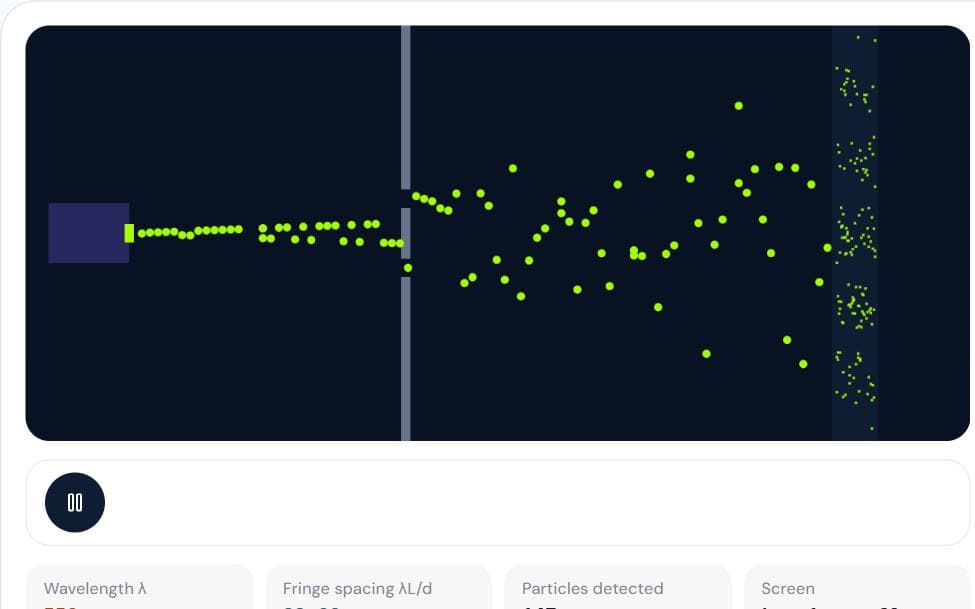
When two waves overlap, their displacements add. Where crest meets crest the result is a bigger wave (constructive interference); where crest meets trough they cancel (destructive interference). Two sources produce a fixed pattern of bright and dark bands, and light passing through two slits does the same — Young's double-slit experiment.

This wave interference simulation shows water, sound and light waves from one or two sources, and light through one slit or two slits. Change the frequency or wavelength, the source separation and the slit width, and use the side view and graphs to measure the pattern. It covers Wave Optics in Class 12, superposition in Class 11, and the fringe-width problems in JEE and NEET.

Also covers: waves intro, ripple tank, double slit, single slit diffraction, young's experiment, constructive destructive.
Frequently asked questions

What happens to the fringe width if the slits are moved closer together?

The fringes spread out. β = λD/d, so a smaller d gives a larger β.

Why do we not see interference from two ordinary light bulbs?

Their light is not coherent — the phase difference changes randomly, so the pattern shifts millions of times a second and averages out.

What does a single slit do on its own?

It diffracts: a wide bright central band with weaker bands on either side. Narrower slits spread the light more.