Skip to content
Light & Optics · Physics

Images in Two Angled Mirrors Simulation

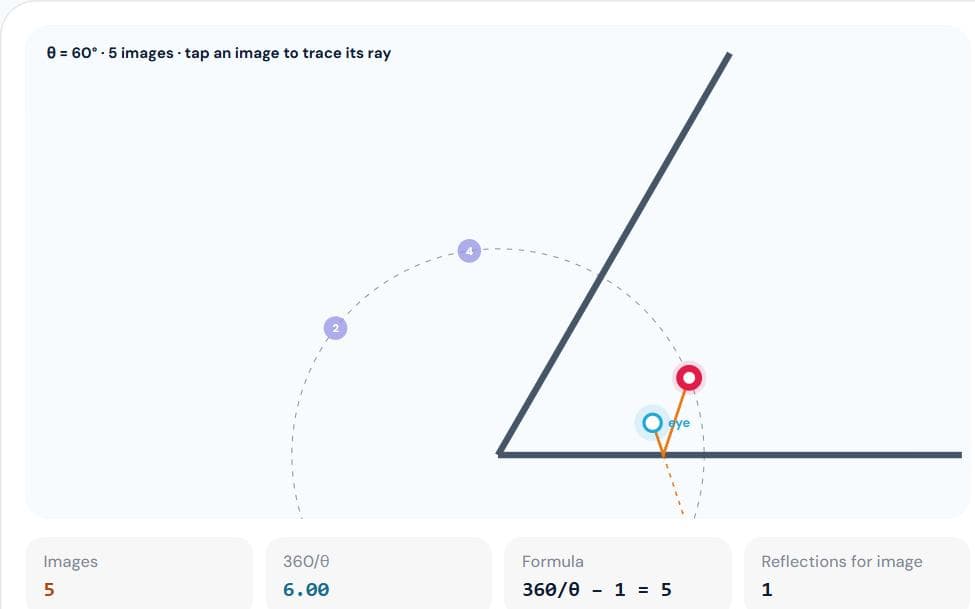
Two hinged mirrors and an object: every image formed by reflection chains, all on one circle round the hinge, with the true ray path traced to any image you tap. See 360/θ − 1 at even ratios and the position rule when it is odd.

Interactive virtual lab · no download · works on phones and laptops

Chapter
Ray Optics
For
Class 7–12 · JEE
Time
~12 min

Images in Two Angled Mirrors is a Pro simulation

Pro opens all 125 virtual labs — 483 simulations with guides and quizzes.

How to use it

  1. 1Change the angle; drag the object and the eye.
  2. 2Tap an image to trace its ray bounce by bounce.

What to notice

  • Images lie on a circle centred on the hinge.
  • 90° gives 3 images, 60° gives 5.
  • For odd 360/θ the count depends on where the object is.

For teachers

A ready-made teaching kit comes with this lab

  • Lesson plan

    19 min, 4 steps

  • Ask the class

    3 questions with answers

  • Quick quiz

    5 questions, printable

  • Key formulas

    1 formulas

About the Images in Two Angled Mirrors simulation

Two plane mirrors hinged at an angle make several images: each mirror reflects the object and the images formed by the other mirror, as long as they are in front of it, until an image falls behind both. This simulation builds that chain of reflections exactly, shows that all the images lie on a circle centred on the hinge, and traces the actual light path to any image you tap.

At 90° you get 3 images, at 60° five; as the angle closes the images multiply — the kaleidoscope effect. When 360/θ is even the count is 360/θ − 1; when it is odd it depends on the object: 360/θ − 1 on the bisector, 360/θ off it.

Also covers: two plane mirrors at an angle, number of images 360/theta - 1, kaleidoscope, multiple reflection, plane mirror images.
Frequently asked questions

How many images are formed by two mirrors at 60°?

360/60 − 1 = 5.

Why do the images lie on a circle?

Every reflection keeps the distance from the hinge (which lies on both mirrors), so all images are as far from the hinge as the object.

What happens when the mirrors are parallel?

The angle is 0°, the chain never ends, and you see an endless row of images.