Skip to content
Mechanics · Physics

Lift & Apparent Weight Simulation

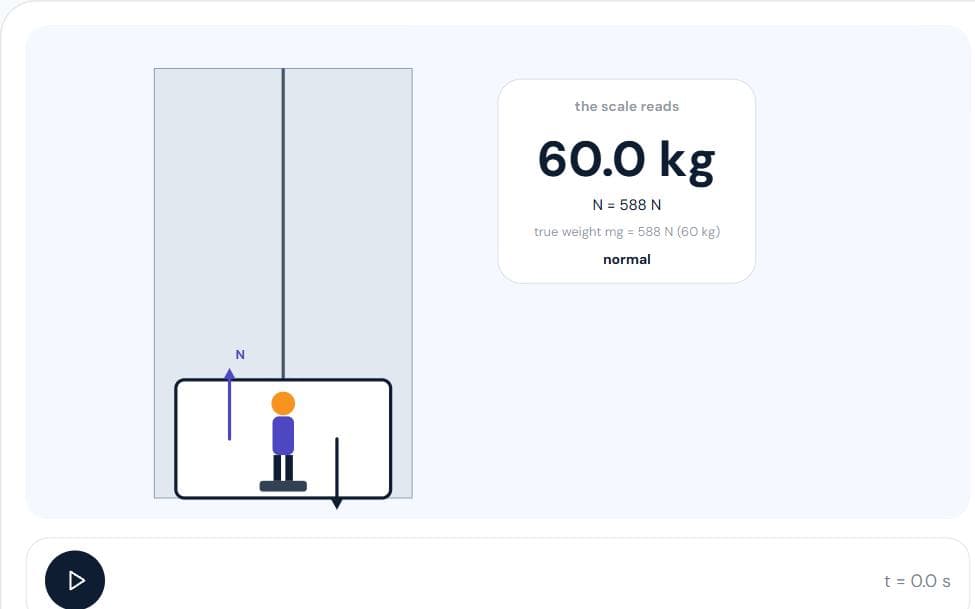
Stand on a bathroom scale in a lift and watch the reading change as it speeds up, cruises and slows down. The scale shows N = m(g + a): more going up, less going down, zero when the cable snaps.

Interactive virtual lab · no download · works on phones and laptops

Chapter
Laws of Motion (NLM)
For
Class 9 · Class 11 · JEE · NEET
Time
~10 min

Lift & Apparent Weight is a Pro simulation

Pro opens all 125 virtual labs — 483 simulations with guides and quizzes.

How to use it

  1. 1Pick a trip and press play.
  2. 2Read the scale and the graphs together.
  3. 3Set a yourself to try any acceleration.

What to notice

  • The scale reads the normal force N = m(g + a), not the weight mg.
  • Only acceleration changes the reading; constant velocity in either direction reads mg.
  • Slowing down on the way up feels like speeding up on the way down.
  • In free fall N = 0: apparent weightlessness, though gravity still acts.

For teachers

A ready-made teaching kit comes with this lab

  • Lesson plan

    18 min, 4 steps

  • Ask the class

    4 questions with answers

  • Quick quiz

    5 questions, printable

  • Key formulas

    2 formulas

About the Lift & Apparent Weight simulation

A weighing scale measures how hard it pushes up on you — the normal force — not the pull of gravity. Standing still or moving at a steady speed, that push equals your weight. In an accelerating lift the scale must also supply the force that accelerates you, so it reads N = m(g + a) with a taken positive upwards.

This lift simulation puts a person on a bathroom scale and runs a trip: speeding up, cruising and slowing down on the way up or down, or a cable that snaps. The scale, its graph and the force arrows update together, so you can see that the reading depends on the acceleration alone, and that it drops to zero in free fall — apparent weightlessness.

Also covers: apparent weight, weight in a lift, elevator problem, weightlessness, scale reading in lift, normal reaction, free fall lift.
Frequently asked questions

Why do you feel heavier in a lift that starts going up?

The floor has to push you up harder than your weight to accelerate you upwards: N = m(g + a) is more than mg.

Does your weight change in a lift?

Your true weight mg does not. Your apparent weight — the scale reading — changes with the lift's acceleration.

What does a scale read in a lift moving at constant speed?

Exactly mg. With no acceleration there is no extra force, whichever way the lift is moving.

Why is an astronaut weightless in orbit?

The astronaut and the spacecraft fall around the Earth together with the same acceleration, so nothing pushes on the astronaut: N = 0, as in the lift with a broken cable.