Skip to content
Mechanics · Physics

Archimedes' Lever: Moving the Earth Simulation

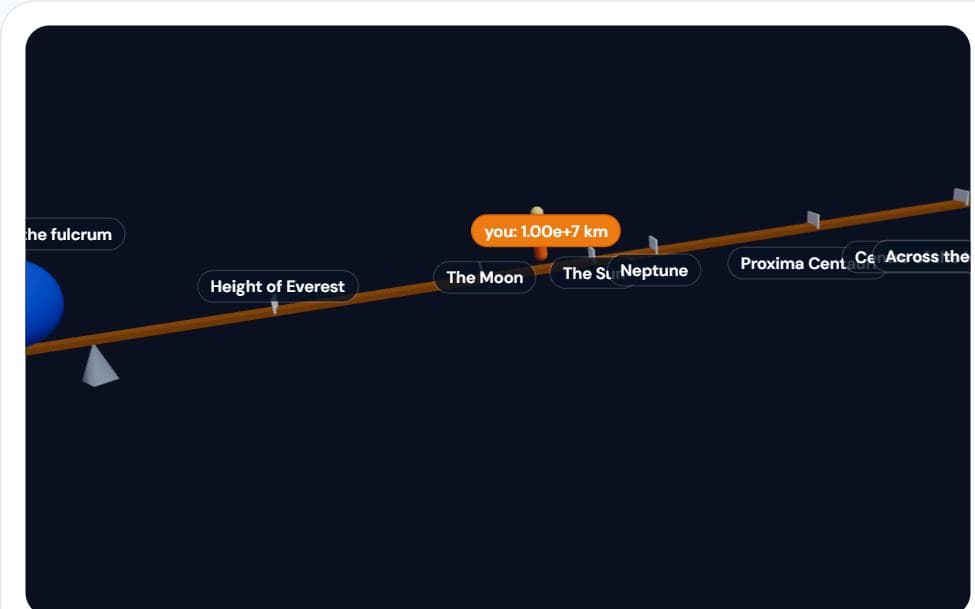
Balance the Earth against a person on a lever drawn on a logarithmic scale: the arm needed reaches past the Andromeda galaxy. Fly along the beam past the Moon, the Sun and the Milky Way, and see what lifting the Earth by a millimetre would cost.

Interactive virtual lab · no download · works on phones and laptops

Chapter
System of Particles and Rotational Motion
For
Class 9–11
Time
~8 min

Archimedes' Lever: Moving the Earth is a Pro simulation

Pro opens all 125 virtual labs — 483 simulations with guides and quizzes.

How to use it

  1. 1Change your weight and where you stand.
  2. 2Use the camera buttons to fly to the fulcrum or to yourself.

What to notice

  • Balance needs W₁d₁ = W₂d₂.
  • Doubling your weight halves the arm.
  • What you gain in force you pay in distance.

For teachers

A ready-made teaching kit comes with this lab

  • Lesson plan

    17 min, 4 steps

  • Ask the class

    3 questions with answers

  • Quick quiz

    5 questions, printable

  • Key formulas

    1 formulas

About the Archimedes' Lever: Moving the Earth simulation

Archimedes boasted that with a place to stand he could move the Earth. The law of the lever agrees: a lever balances when the moments match, W₁d₁ = W₂d₂. Put the Earth 1 m from the fulcrum and a 700 N person must stand about 8.4 × 10²² m out — beyond the Andromeda galaxy. This simulation draws the beam on a logarithmic scale so twenty-three powers of ten fit, with markers for the Moon, the Sun, the nearest star and the galaxy.

Change your weight and the balance point moves; fly the camera out along the beam. And notice the price: to lift the Earth by a millimetre, your end must move a millimetre times the lever ratio — about nine thousand light years. The law is not wrong; it simply has no upper limit and does not care whether such a lever could exist.

Also covers: give me a place to stand, archimedes lever, law of the lever, principle of moments, mechanical advantage.

Frequently asked questions

Could a lever really move the Earth?

In principle the law of the lever has no limit, but the arm would need to be about 10²³ m long and you would have to walk thousands of light years to lift the Earth by a millimetre.

What does a lever trade?

Force for distance: the small force moves a large distance, the large load a small one, and the work is the same (ideally).

What is the principle of moments?

For a body in rotational equilibrium, the sum of clockwise moments about any point equals the sum of anticlockwise moments.