Skip to content
Mechanics · Physics

Balancing Act Simulation

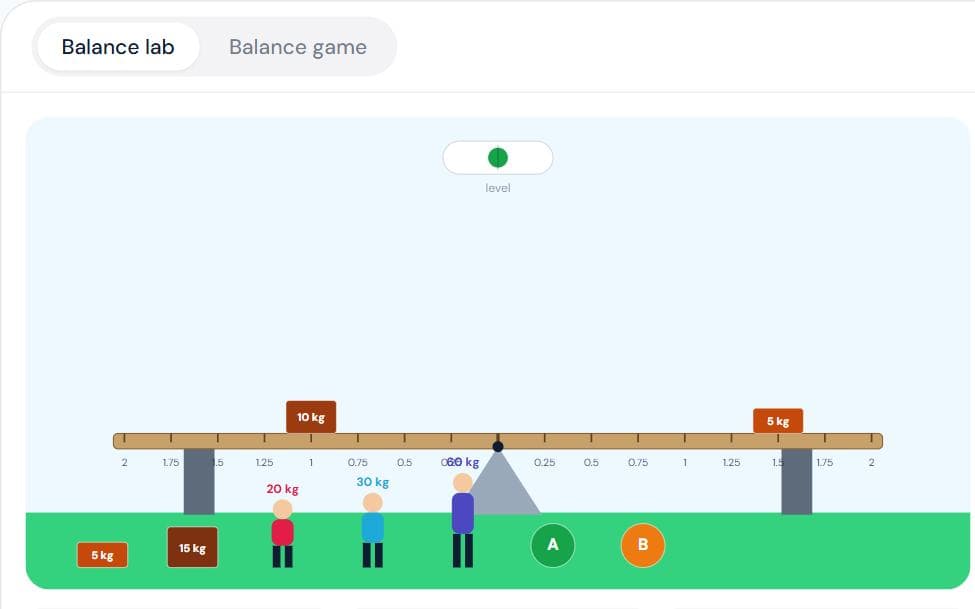
Place bricks and people on a seesaw and remove the supports. It balances when the moments on each side are equal — then play the balance game.

Interactive virtual lab · no download · works on phones and laptops

Chapter
System of Particles and Rotational Motion
For
Class 9 · Class 11
Time
~10 min

Balancing Act is a Pro simulation

Pro opens all 125 virtual labs — 483 simulations with guides and quizzes.

How to use it

  1. 1Drag objects from the shelf onto the plank's marks.
  2. 2Remove the supports to see which way it tips.
  3. 3Show the moment arms, the levels and the forces.
  4. 4Game: predict the tilt or balance the given mass.

What to notice

  • Moment = mass × g × distance from the pivot.
  • The plank balances when clockwise moments equal anticlockwise moments.
  • Half the mass at twice the distance balances the same.

For teachers

A ready-made teaching kit comes with this lab

  • Lesson plan

    19 min, 4 steps

  • Ask the class

    3 questions with answers

  • Quick quiz

    6 questions, printable

  • Key formulas

    2 formulas

About the Balancing Act simulation

A seesaw balances when the turning effects on both sides are equal. The turning effect of a force — its torque, or moment — is the force times its distance from the pivot. A light child far from the pivot can balance a heavy adult close to it.

In this balancing act simulation you place bricks on a plank, decide whether it will tip left, tip right or stay level, then take the supports away and see. It teaches the principle of moments for Class 9 and rotational equilibrium (System of Particles and Rotational Motion) for Class 11.

Also covers: torque, moment, lever, seesaw, principle of moments, equilibrium.
Frequently asked questions

What is the principle of moments?

For a body in balance, the sum of clockwise moments about the pivot equals the sum of anticlockwise moments.

A 20 kg child sits 2 m from the pivot. Where must a 40 kg child sit?

At 1 m on the other side: 20 × 2 = 40 × 1.

Does the length of the plank matter?

Not for a uniform plank pivoted at its centre — its own weight acts through the pivot and has no moment.