Skip to content
Light & Optics · Physics

Bending Light Simulation

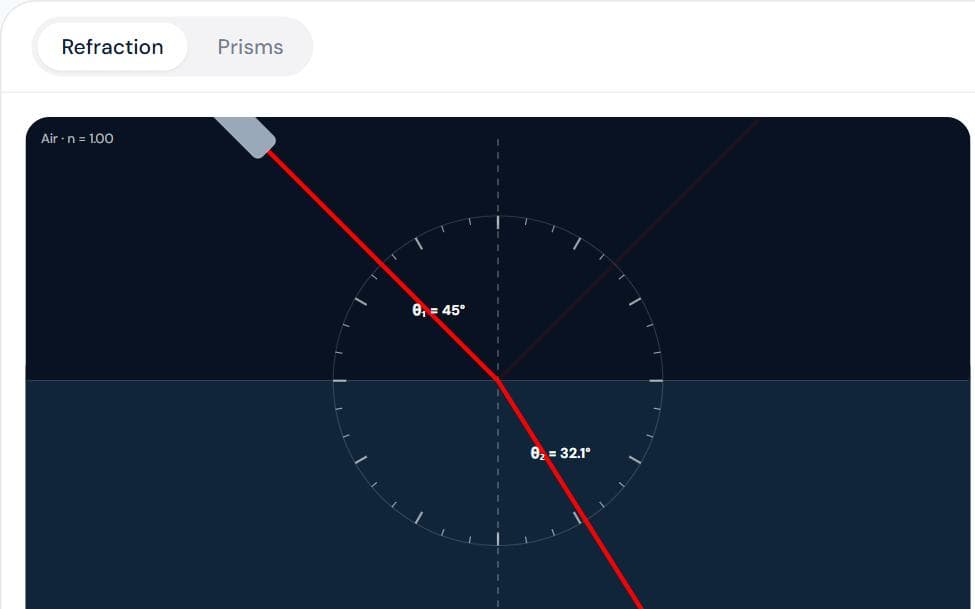
Shine a laser from air into water or glass and watch it bend. Measure angles with the protractor, find total internal reflection, and split white light with a prism.

Interactive virtual lab · no download · works on phones and laptops

Chapter
Ray Optics
For
Class 10 · Class 12 · JEE · NEET
Time
~12 min

Bending Light is a Pro simulation

Pro opens all 125 virtual labs — 483 simulations with guides and quizzes.

How to use it

  1. 1Drag the laser to change the angle of incidence.
  2. 2Choose the two materials, or set n directly.
  3. 3Change the wavelength, or switch to white light.
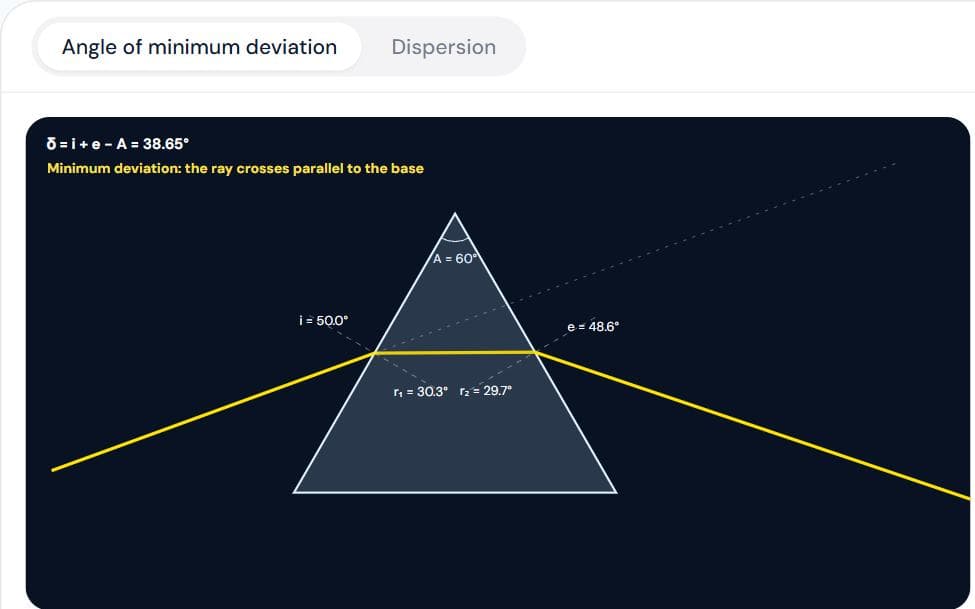
  4. 4Prisms tab: drag and rotate prisms in the beam.

What to notice

  • n₁ sin θ₁ = n₂ sin θ₂ (Snell's law).
  • Light bends toward the normal entering a denser medium.
  • Beyond the critical angle all the light reflects back.
  • Violet bends more than red, which is why a prism makes a rainbow.

For teachers

A ready-made teaching kit comes with this lab

  • Lesson plan

    21 min, 4 steps

  • Ask the class

    3 questions with answers

  • Quick quiz

    7 questions, printable

  • Key formulas

    3 formulas

About the Bending Light simulation

Light bends — refracts — when it passes from one material into another, because it travels at different speeds in them. Snell's law relates the angles to the refractive indices. Going from a denser to a less dense medium beyond the critical angle, light cannot get out at all and is totally internally reflected.

In this bending light simulation you aim a laser at the boundary between air, water, glass and other materials, measure angles with a protractor, change the refractive index, and switch to a wave view. The prisms screen splits white light into colours. It covers Refraction of Light in Class 10 and Ray Optics in Class 12, JEE and NEET.

Also covers: refraction, snell's law, refractive index, total internal reflection, critical angle, prism, dispersion.
Frequently asked questions

What is the critical angle for glass (n = 1.5) to air?

sin C = 1/1.5, so C ≈ 41.8°.

Why does light bend towards the normal in glass?

It slows down in glass; the part of the wavefront that enters first slows first, turning the beam towards the normal.

Why does a prism split white light?

The refractive index is slightly different for each colour (dispersion), so violet bends more than red.