Skip to content
Modern Physics · Physics

Beta Decay & Half-life Simulation

A neutron turns into a proton and an electron flies out. Watch carbon-14 and hydrogen-3 decay one nucleus at a time, then in hundreds, and date a sample from what is left.

Interactive virtual lab · no download · works on phones and laptops

Chapter
Nuclei
For
Class 12 · JEE · NEET
Time
~12 min

Beta Decay & Half-life is a Pro simulation

Pro opens all 125 virtual labs — 483 simulations with guides and quizzes.

How to use it

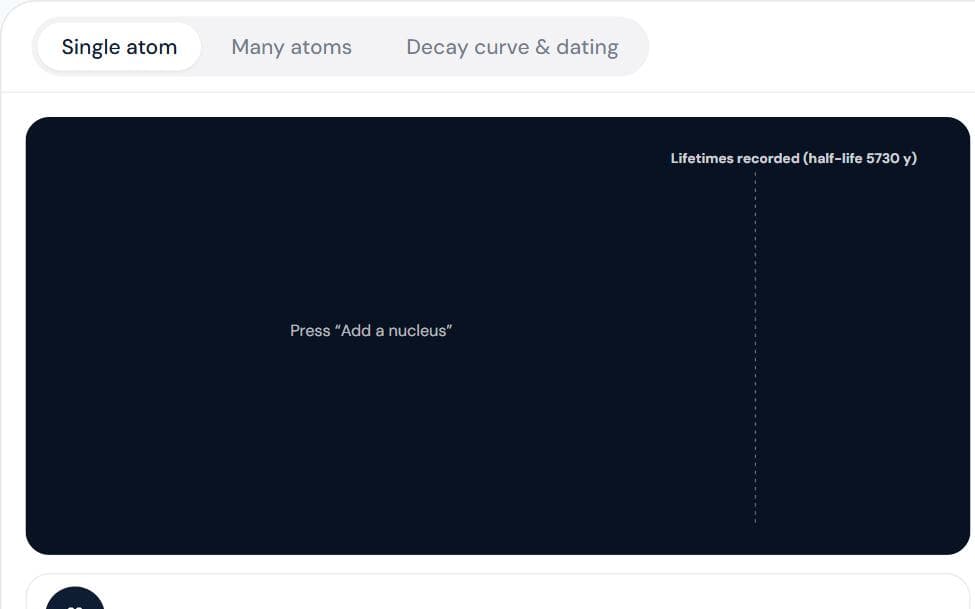
  1. 1Single atom: add a nucleus and watch for the electron leaving.
  2. 2Many atoms: add nuclei in batches and watch the pie and the counts.
  3. 3Decay curve: start a sample and read the fraction left against time.
  4. 4Switch isotope to compare half-lives.

What to notice

  • In β⁻ decay the mass number stays the same and the atomic number rises by 1.
  • An antineutrino shares the energy, so the electron's speed varies from decay to decay.
  • Each half-life about half of what remains decays — whatever the starting amount.
  • The fraction left tells you the age: t = T½ · log₂(N₀/N).

For teachers

A ready-made teaching kit comes with this lab

  • Lesson plan

    20 min, 4 steps

  • Ask the class

    4 questions with answers

  • Quick quiz

    6 questions, printable

  • Key formulas

    3 formulas

About the Beta Decay & Half-life simulation

In beta-minus decay a neutron inside a nucleus turns into a proton, sending out an electron and an antineutrino. The mass number stays the same and the atomic number goes up by one: carbon-14 becomes nitrogen-14. Like all radioactive decay it follows a half-life, which is what makes carbon dating possible.

In this beta decay simulation you watch single carbon-14 or hydrogen-3 nuclei decay, then a large sample, and read the fraction left against time. The dating screen works backwards: from the fraction of carbon-14 left, find the sample's age. It covers Nuclei in Class 12, JEE and NEET.

Also covers: beta minus, carbon-14, neutrino, radioactive dating, half life.
Frequently asked questions

What is the half-life of carbon-14?

About 5730 years.

A sample has a quarter of its original carbon-14. How old is it?

Two half-lives: about 11 460 years.

Why does the atomic number increase in beta decay?

A neutron becomes a proton, so the nucleus gains one positive charge.

How does carbon dating work?

Living things keep taking in carbon-14 from the air, so their share of it stays steady. After death the intake stops and the carbon-14 decays with a 5730-year half-life, so the fraction left gives the time since death — useful up to about 50 000 years.