Skip to content
Light & Optics · Physics

Blackbody Spectrum Simulation

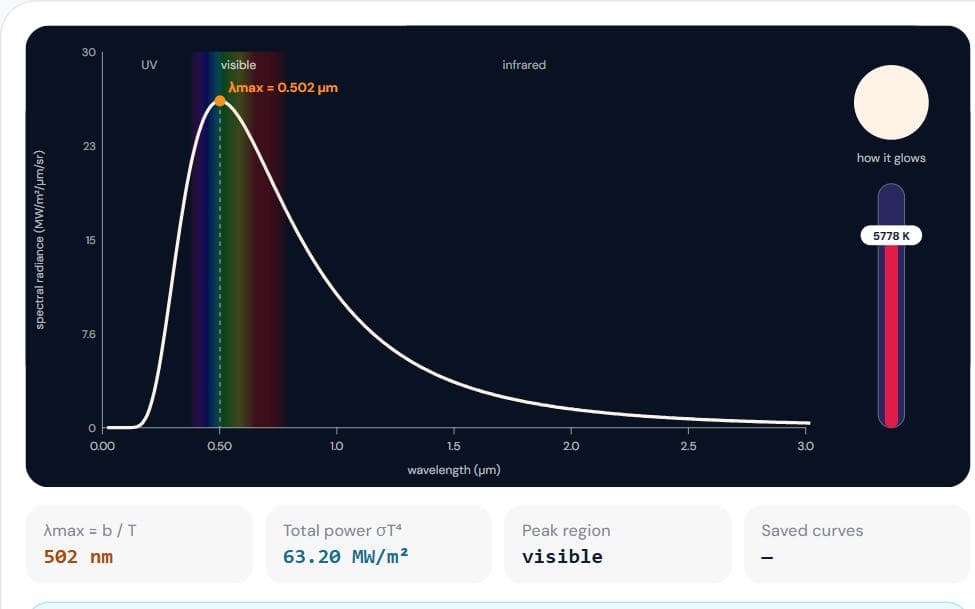
Heat an object from 300 K to 10 000 K and watch its glow change colour. The spectrum's peak slides by Wien's law and the total power climbs as T⁴.

Interactive virtual lab · no download · works on phones and laptops

Chapter
Dual Nature · Thermal Properties
For
Class 11 · Class 12 · JEE
Time
~8 min

Blackbody Spectrum is a Pro simulation

Pro opens all 125 virtual labs — 483 simulations with guides and quizzes.

How to use it

  1. 1Drag the thermometer or choose Sun, bulb, Sirius A or Earth.
  2. 2Save a curve to compare.
  3. 3Zoom the axes; turn on the peak marker and labels.

What to notice

  • λ_max · T = 2.898 × 10⁻³ m K (Wien's law).
  • Hotter objects peak at shorter wavelengths: red-hot → white-hot → blue.
  • Total power per area σT⁴ grows very fast with temperature.
  • A 3000 K bulb puts most of its energy into infrared — heat, not light.

For teachers

A ready-made teaching kit comes with this lab

  • Lesson plan

    18 min, 4 steps

  • Ask the class

    3 questions with answers

  • Quick quiz

    6 questions, printable

  • Key formulas

    2 formulas

About the Blackbody Spectrum simulation

Every hot object glows, and an ideal 'blackbody' glows with a spectrum that depends only on its temperature. As it gets hotter it gives out far more energy in total and the peak of the spectrum shifts to shorter wavelengths — from infrared, to red-hot, to white-hot and blue. Planck explained the shape by assuming light comes in quanta, starting quantum physics.

In this blackbody spectrum simulation you set the temperature (or pick the Sun, a light bulb or the Earth), read the peak wavelength and total power, save curves to compare and zoom the axes. It covers Wien's law and Stefan's law in Thermal Properties of Matter (Class 11) and Dual Nature of Radiation in Class 12 and JEE.

Also covers: planck's law, wien's displacement law, stefan boltzmann, thermal radiation, temperature colour.
Frequently asked questions

Where does the Sun's spectrum peak?

At about 500 nm (visible green-blue), for a surface temperature near 5800 K.

If the temperature doubles, what happens to the power radiated?

It rises 16 times, because P ∝ T⁴.

Why do hotter stars look blue?

Their peak wavelength is shorter (λ_max ∝ 1/T), shifting the light towards blue.