Skip to content
Modern Physics · Physics

Build a Nucleus Simulation

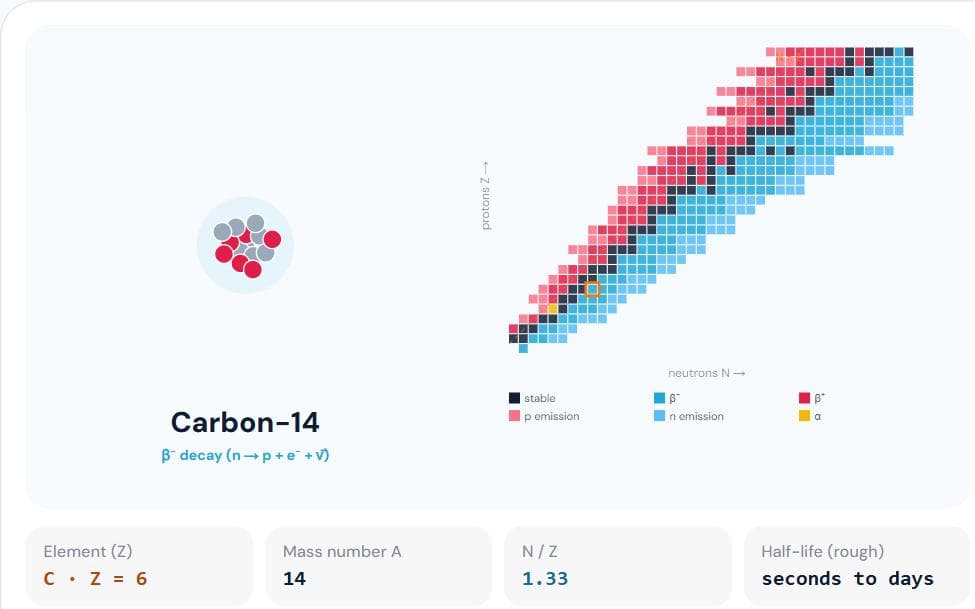
Add protons and neutrons and see which nucleus you made, whether it is stable, and how it decays. Find it on the chart of nuclides and follow its decay path.

Interactive virtual lab · no download · works on phones and laptops

Chapter
Nuclei
For
Class 12 · JEE · NEET
Time
~12 min

Build a Nucleus is a Pro simulation

Pro opens all 125 virtual labs — 483 simulations with guides and quizzes.

How to use it

  1. 1Use + and − to add or remove protons and neutrons.
  2. 2Press a decay button to watch the nucleus change.
  3. 3Read the half-life and the most likely decay.
  4. 4Follow your nucleus on the nuclide chart.

What to notice

  • Changing protons changes the element; changing neutrons changes the isotope.
  • Light stable nuclei have N ≈ Z; heavy ones need more neutrons than protons.
  • Too many neutrons → β⁻ decay; too few → β⁺ decay; very heavy → α decay.
  • Each decay moves the nucleus one step on the chart toward the stability band.

For teachers

A ready-made teaching kit comes with this lab

  • Lesson plan

    20 min, 4 steps

  • Ask the class

    3 questions with answers

  • Quick quiz

    6 questions, printable

  • Key formulas

    2 formulas

About the Build a Nucleus simulation

A nucleus is held together by the strong force between protons and neutrons, against the electric repulsion of the protons. Only certain combinations are stable: light nuclei like roughly equal numbers of each, and heavy ones need extra neutrons. Too many or too few neutrons and the nucleus decays.

In this build a nucleus simulation you add and remove protons and neutrons, see which element and isotope you have made, whether it is stable and roughly how long it lasts, and where it sits on the chart of nuclides. It covers Nuclei in Class 12, JEE and NEET.

Also covers: isotopes, nuclide chart, stability, alpha decay, beta decay, neutron proton ratio.
Frequently asked questions

What decides which element a nucleus is?

The number of protons, Z. Changing the number of neutrons gives a different isotope of the same element.

Why do heavy nuclei need more neutrons than protons?

Extra neutrons add strong-force attraction without adding electric repulsion.

What happens to a nucleus with too many neutrons?

It usually undergoes beta-minus decay, turning a neutron into a proton.