Skip to content
Electricity · Physics

Capacitor Lab Simulation

Change the plate area, the gap and the battery voltage and watch charge build up on a capacitor. Then disconnect it and discharge it through a bulb.

Interactive virtual lab · no download · works on phones and laptops

Chapter
Electrostatic Potential and Capacitance
For
Class 12 · JEE · NEET
Time
~12 min

Capacitor Lab is a Pro simulation

Pro opens all 125 virtual labs — 483 simulations with guides and quizzes.

How to use it

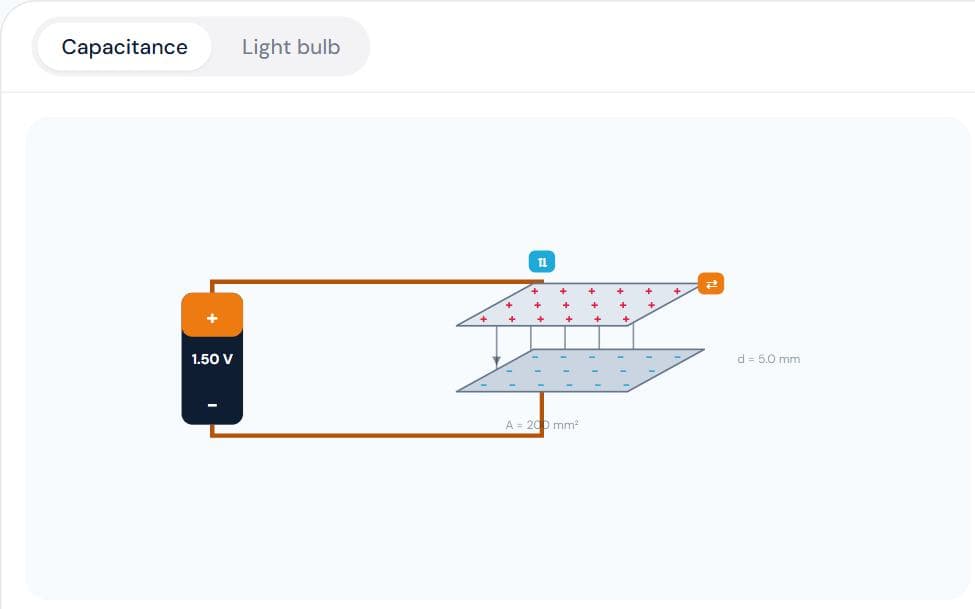
  1. 1Drag the plate edge to change area, the top plate to change the gap.
  2. 2Change the battery voltage, or disconnect it.
  3. 3Turn on field lines, charges and the voltmeter.
  4. 4Light bulb tab: flip the switch to discharge.

What to notice

  • C = ε₀A/d: bigger plates or a smaller gap → more capacitance.
  • Q = CV and stored energy U = ½CV².
  • The field between the plates is E = V/d, uniform and pointing + to −.
  • Disconnected from the battery, Q stays fixed and V changes when you move the plates.

For teachers

A ready-made teaching kit comes with this lab

  • Lesson plan

    21 min, 4 steps

  • Ask the class

    3 questions with answers

  • Quick quiz

    7 questions, printable

  • Key formulas

    4 formulas

About the Capacitor Lab simulation

A capacitor stores charge on two plates separated by a gap. Its capacitance — the charge stored per volt — grows with the plate area and shrinks as the plates move apart. A charged capacitor also stores energy in the electric field between its plates, which it can release into a bulb.

In this capacitor lab you change the plate area and separation, connect or disconnect the battery, and read the capacitance, charge, field and stored energy on meters. A second screen discharges the capacitor through a light bulb. It covers Electrostatic Potential and Capacitance in Class 12, JEE and NEET.

Also covers: parallel plate capacitor, capacitance, charge, stored energy, electric field, rc discharge.
Frequently asked questions

What happens to the capacitance if the plate separation is doubled?

It halves, since C = ε₀A/d.

If the battery is disconnected and the plates pulled apart, what happens to the voltage?

The charge Q stays the same, C falls, so V = Q/C rises.

Where is the energy of a capacitor stored?

In the electric field between the plates.