Skip to content
Mechanics · Physics

Centre of Mass Simulation Lab: 20 Interactive Experiments

Twenty experiments on one centre-of-mass engine, from two beads on a rail to JEE Advanced: drag particles in 1D, 2D and 3D; balance a metre rule; hang a plate from its holes and watch the plumb lines cross; semicircular wires, plates and hemispheres; a triangle with draggable corners; rods of varying density; plates with holes as negative mass; then the motion of the centre of mass — internal springs, collisions in the centre-of-mass frame, a tumbling throw, a bursting shell, walking on a plank, the ballistic pendulum, binary orbits, a chain sliding off a table, a block on a free wedge, a three-fragment explosion and jumping off a trolley.

Interactive virtual lab · no download · works on phones and laptops

Chapter
System of Particles and Rotational Motion
For
Class 7–12 · JEE · NEET
Time
~45 min

Centre of Mass Lab is a Pro simulation

Pro opens all 151 virtual labs — 643 simulations with guides and quizzes.

How to use it

  1. 1Pick a module from the list (20, in four groups); set your level at the top right for more controls.
  2. 2Drag the orange knobs and handles — beads, weights, corners, holes, arrow tips — or type exact values.
  3. 3Use Predict before you press play, then Derive, Questions, Practise (fresh numericals each time) and Compare.

What to notice

  • r_cm = Σmᵢrᵢ/M: closer to the heavier masses; a hole is negative mass at its centre.
  • Semicircular wire 2R/π, plate 4R/3π, hemispherical shell R/2, solid hemisphere 3R/8; a triangle's at its centroid.
  • M a_cm = F_ext: internal forces — springs, explosions, collisions, walking — never move the centre of mass.
  • With no external horizontal force, x_cm stays put: the plank, the boat and the wedge slide back.
  • In the centre-of-mass frame total momentum is zero, which makes collisions simple.

For teachers

A ready-made teaching kit comes with this lab

  • Lesson plan

    41 min, 4 steps

  • Ask the class

    5 questions with answers

  • Quick quiz

    7 questions, printable

  • Key formulas

    9 formulas

About the Centre of Mass Lab simulation

The centre of mass is the one point that lets you treat a whole system — a pair of beads, a cut-out plate, a bursting shell, a man on a boat — as a single particle. This Centre of Mass simulation lab builds the idea from the ground up: drag beads along a rail and particles around a 3D room and watch the black-and-white marker follow the heavier masses; balance a metre rule; hang a plate from different holes and see the plumb lines cross at its centre of gravity.

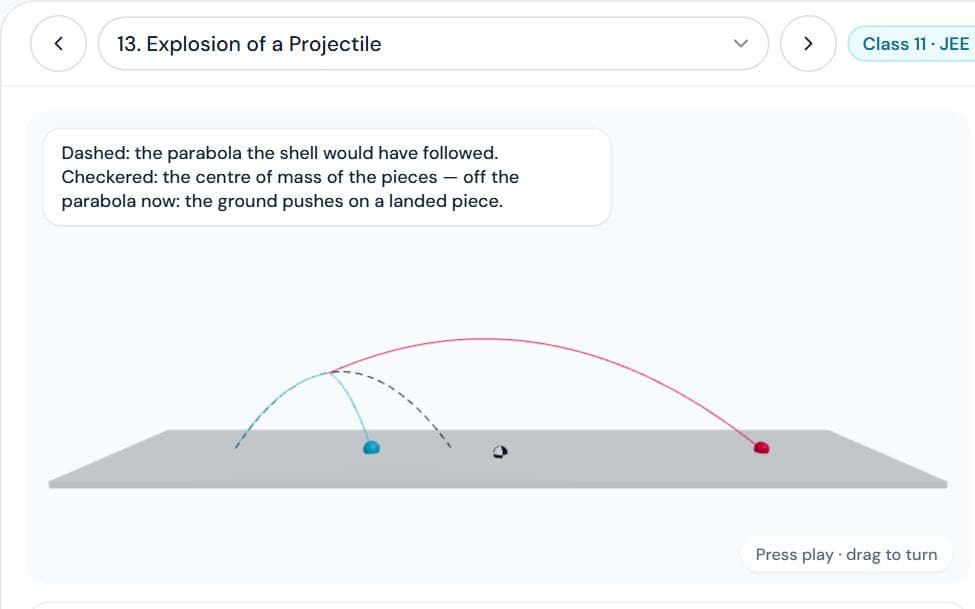
Then the shapes JEE asks about — semicircular wires and plates, hemispherical shells and solid hemispheres, triangles, rods whose density varies, and plates with holes treated as negative mass — and the motion of the centre of mass: internal springs, collisions viewed from the centre-of-mass frame, a tumbling throw whose centre still follows a parabola, a shell that bursts in mid-air, walking on a plank, the ballistic pendulum, binary orbits, a chain sliding off a table, a block on a wedge that is free to slide, a three-fragment explosion and jumping off a trolley.

All twenty modules share one engine, so every number agrees from one experiment to the next. Each has a prediction that hides the answer until you commit, a derivation, concept questions with hints and fresh practice numericals.

Also covers: centre of mass, center of mass, system of particles, centre of mass of two particles, centre of mass formula, centre of mass in 3d, balancing a metre rule, principle of moments, centre of gravity, plumb line method, irregular lamina centre of gravity, centre of mass of semicircular ring, centre of mass of semicircular disc, centre of mass of hemisphere, centre of mass of triangle, centroid, non uniform rod centre of mass, variable density rod, centre of mass of composite body, cavity negative mass, disc with a hole, velocity of centre of mass, acceleration of centre of mass, internal forces, spring between two blocks, centre of mass frame, collision in com frame, oblique collision, projectile explosion, shell bursts, man walking on plank, man on boat, ballistic pendulum, two body problem, binary star, falling chain, chain sliding off table, block on movable wedge, wedge displacement, three fragment explosion, jumping off a trolley, recoil, jee advanced centre of mass.
Frequently asked questions

Can the centre of mass lie outside the body?

Yes. A ring's centre of mass is at its centre, where there is no material; so is a boomerang's, in the empty space between its arms. It is a mass-weighted average position, not a piece of the body.

How do you find the centre of mass of a plate with a hole?

Treat the plate as the full shape plus the cut-out piece with negative mass. With areal density σ: x_cm = (σA·x_A − σa·x_a)/(σA − σa). For a disc of radius R with a hole of radius r centred at distance d, the centre of mass moves r²d/(R² − r²) away from the hole.

Why does the boat move back when a person walks forward on it?

With no horizontal external force (still water, drag neglected), the horizontal position of the centre of mass of person + boat cannot change. As the person moves forward, the boat must move back so that m·(person's displacement) + M·(boat's displacement) = 0.

Does an explosion change the motion of the centre of mass?

No. The forces of the explosion are internal, so the total momentum is unchanged and the centre of mass of the fragments keeps following the original path — a parabola for a shell — until a fragment hits the ground, when the ground's force (external) takes over.

What is the centre-of-mass frame, and why use it?

It is the frame moving with the centre of mass. In it the total momentum is zero, so two colliding bodies always have equal and opposite momenta: an elastic collision just reverses their velocities. Solve there, then add V_cm back to return to the lab.