Skip to content
Electricity · Physics

Charge Between Two Charges Simulation

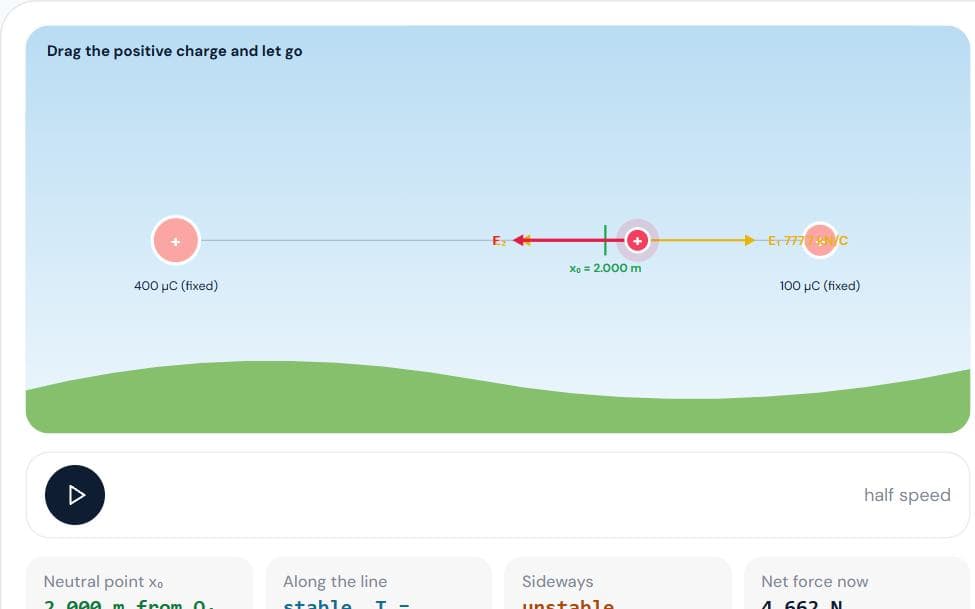
Place a free charge between two fixed charges, find the point where the forces balance and nudge it away. It oscillates one way and escapes the other.

Interactive virtual lab · no download · works on phones and laptops

Chapter
Electric Charges and Fields · Oscillations
For
Class 12 · JEE
Time
~10 min

Charge Between Two Charges is a Pro simulation

Pro opens all 125 virtual labs — 483 simulations with guides and quizzes.

How to use it

  1. 1Set the two fixed charges and the free charge.
  2. 2Drag the free charge and let go.
  3. 3Use the nudge buttons for small displacements.
  4. 4Watch the displacement graphs.

What to notice

  • The neutral point is at x₀ = d√Q₁/(√Q₁ + √Q₂).
  • A positive charge is stable along the line and unstable sideways.
  • A negative charge is the reverse.
  • Small swings are simple harmonic with ω² = 2kq(Q₁/x₀³ + Q₂/(d − x₀)³)/m.

For teachers

A ready-made teaching kit comes with this lab

  • Lesson plan

    18 min, 4 steps

  • Ask the class

    3 questions with answers

  • Quick quiz

    5 questions, printable

  • Key formulas

    2 formulas

About the Charge Between Two Charges simulation

Between two fixed positive charges there is one point where their pushes on a third charge cancel. Displace a positive charge along the line and the nearer charge pushes harder: it is driven back and oscillates. Displace it sideways and both push it further away. A negative charge behaves the other way round. No arrangement of fixed charges holds a charge stable in every direction — Earnshaw's theorem.

This simulation integrates the full Coulomb forces in two dimensions. Drag the free charge and let go, nudge it along the line or sideways, change both fixed charges and the free charge's sign, and compare the measured oscillation with the small-oscillation formula.

Also covers: neutral point, stable equilibrium charge, axial oscillation, earnshaw theorem, small oscillations coulomb.
Frequently asked questions

Where is the neutral point between two like charges?

Closer to the smaller charge, at x₀ = d√Q₁/(√Q₁ + √Q₂) from Q₁.

Is the equilibrium of a charge between two like charges stable?

For a charge of the same sign it is stable along the line joining them and unstable perpendicular to it.

What does Earnshaw's theorem say?

A charge cannot be held in stable equilibrium by electrostatic forces alone: there is always some direction in which it is unstable.