Skip to content
Electricity · Physics

Charges & Fields Simulation

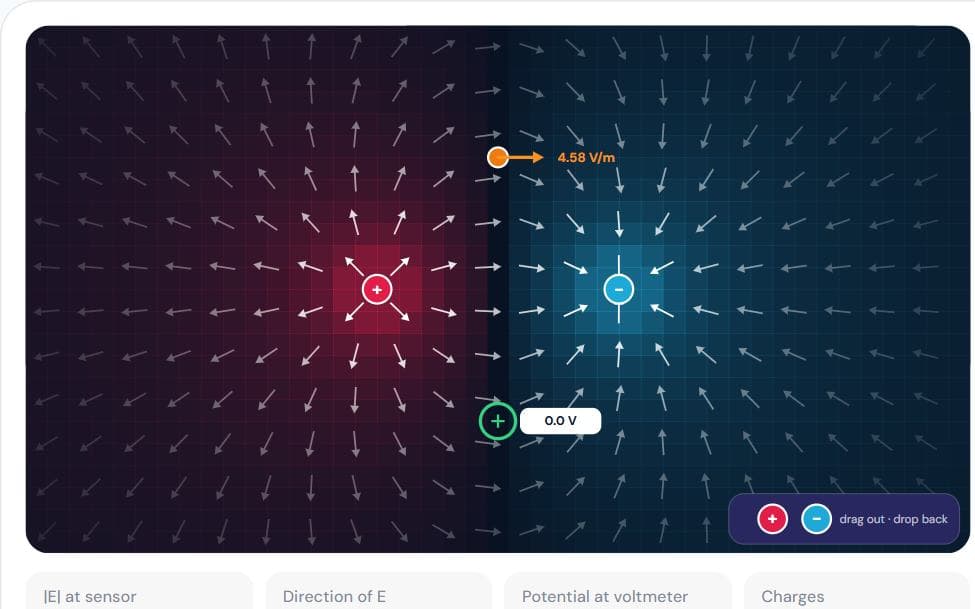
Place positive and negative charges and see the electric field and potential they make. Drag a sensor for E, plot equipotentials, and build a dipole.

Interactive virtual lab · no download · works on phones and laptops

Chapter
Electric Charges and Fields · Electrostatic Potential
For
Class 12 · JEE · NEET
Time
~15 min

Charges & Fields is a Pro simulation

Pro opens all 125 virtual labs — 483 simulations with guides and quizzes.

How to use it

  1. 1Drag charges from the bucket onto the board.
  2. 2Turn on the field arrows, field lines and the potential map.
  3. 3Drag the sensor to read E; tap Plot for an equipotential.
  4. 4Use a preset: dipole, two like charges, capacitor.

What to notice

  • Field lines start on positive charges and end on negative ones.
  • The field from several charges is the vector sum of each one's field.
  • Equipotentials are always perpendicular to field lines.
  • No work is done moving a charge along an equipotential.

For teachers

A ready-made teaching kit comes with this lab

  • Lesson plan

    23 min, 4 steps

  • Ask the class

    3 questions with answers

  • Quick quiz

    7 questions, printable

  • Key formulas

    3 formulas

About the Charges & Fields simulation

A charge sets up an electric field around it: the force a small positive test charge would feel, per coulomb. Field lines leave positive charges and end on negative ones, crowding together where the field is strong. The electric potential is the energy per coulomb at each point; equipotential lines are always at right angles to the field lines.

In this charges and fields simulation you place positive and negative charges, or load a dipole, like charges or a parallel-plate capacitor, and show field lines, field arrows, equipotentials and a potential map, with a sensor for |E| and a voltmeter for V. It covers Electric Charges and Fields and Electrostatic Potential in Class 12, JEE and NEET.

Also covers: electric field lines, equipotential, electric potential, dipole, voltage, superposition.
Frequently asked questions

Why do field lines never cross?

The field has only one direction at each point; crossing lines would give two.

Why are equipotentials perpendicular to field lines?

Moving along an equipotential takes no work, so the force (along the field) must be at right angles to it.

Where is the field zero between two equal like charges?

Exactly halfway between them, where their fields cancel.