Skip to content
Mechanics · Physics

Circular Motion & Banked Roads Simulation

See why a ball moving at constant speed in a circle is still accelerating, and what supplies mv²/r on a flat curve, a banked road and a vertical loop. Find the safe speeds and the √(5gr) needed to loop the loop.

Interactive virtual lab · no download · works on phones and laptops

Chapter
Circular Motion
For
Class 11 · JEE · NEET
Time
~20 min

Circular Motion & Banked Roads is a Pro simulation

Pro opens all 125 virtual labs — 483 simulations with guides and quizzes.

How to use it

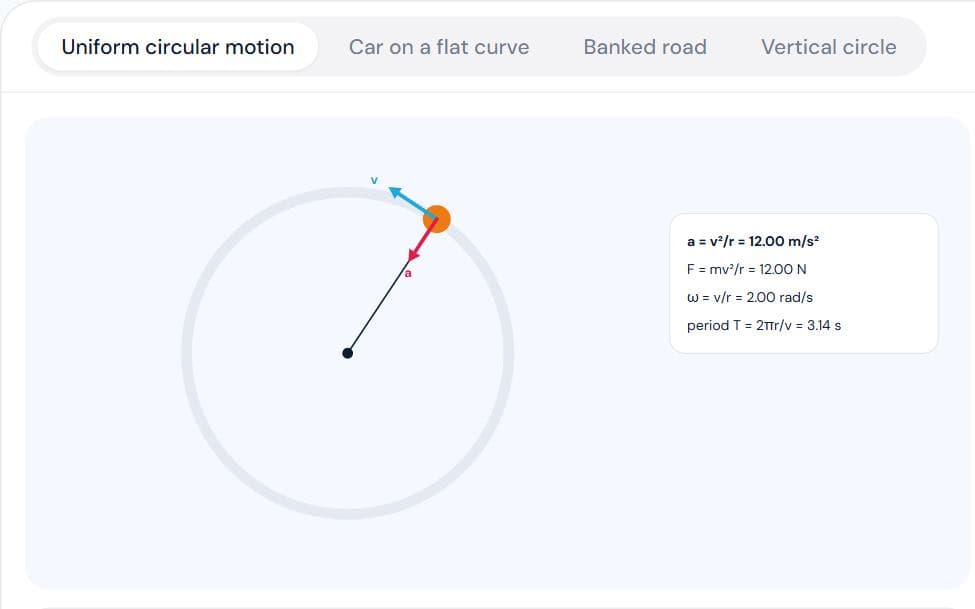
  1. 1Uniform: change v and r, then cut the string.
  2. 2Flat curve and banked road: change speed, radius, μ and the angle.
  3. 3Vertical circle: set the launch speed and press Launch.

What to notice

  • Constant speed, changing velocity: a = v²/r towards the centre.
  • Centripetal force is the net inward force (tension, friction, normal force, gravity), not an extra force.
  • Flat curve: v ≤ √(μgr). Banked road: no friction needed at √(rg tan θ).
  • Vertical circle: T(bottom) − T(top) = 6mg; the full loop needs √(5gr) at the bottom.

For teachers

A ready-made teaching kit comes with this lab

  • Lesson plan

    25 min, 4 steps

  • Ask the class

    4 questions with answers

  • Quick quiz

    6 questions, printable

  • Key formulas

    4 formulas

About the Circular Motion & Banked Roads simulation

A body moving in a circle at constant speed is still accelerating, because its velocity keeps changing direction. That acceleration, v²/r, points towards the centre, so some net force of mv²/r must point inwards: the tension in a string, friction on a car's tyres, the normal force of a banked road, gravity on a satellite. Centripetal force is the name for that job, not a separate force.

This circular motion simulation covers four cases. Uniform circular motion shows the velocity and acceleration vectors and what happens when the string is cut. The flat curve and banked road show what turns a car and the speed limits that follow, including the ideal banking speed at which no friction is needed. The vertical circle follows a mass on a string round a loop, with the tension at every point and the √(5gr) launch speed needed to complete it.

Also covers: uniform circular motion, centripetal acceleration, centripetal force, v squared by r, car on a curve, banking of roads, banked road friction, vertical circular motion, minimum speed at top, root 5gr, tension in vertical circle.

Frequently asked questions

Why is uniform circular motion accelerated?

Acceleration is the rate of change of velocity, and velocity includes direction. In a circle the direction changes continuously, giving an acceleration v²/r towards the centre even at constant speed.

What happens when the string of a whirling stone breaks?

With no inward force the stone moves in a straight line along the tangent at the point where the string broke. It does not fly radially outwards.

Why are roads banked on curves?

Tilting the road turns part of the normal force towards the centre, so the car needs less friction to turn. At the ideal speed √(rg tan θ) it needs none at all.

What is the minimum speed at the top of a vertical circle?

√(gr), when gravity alone supplies the centripetal force and the tension is zero. Energy conservation then makes the minimum speed at the bottom √(5gr).