Skip to content
Human Physiology · Biology

Cochlea & Audible Range Simulation

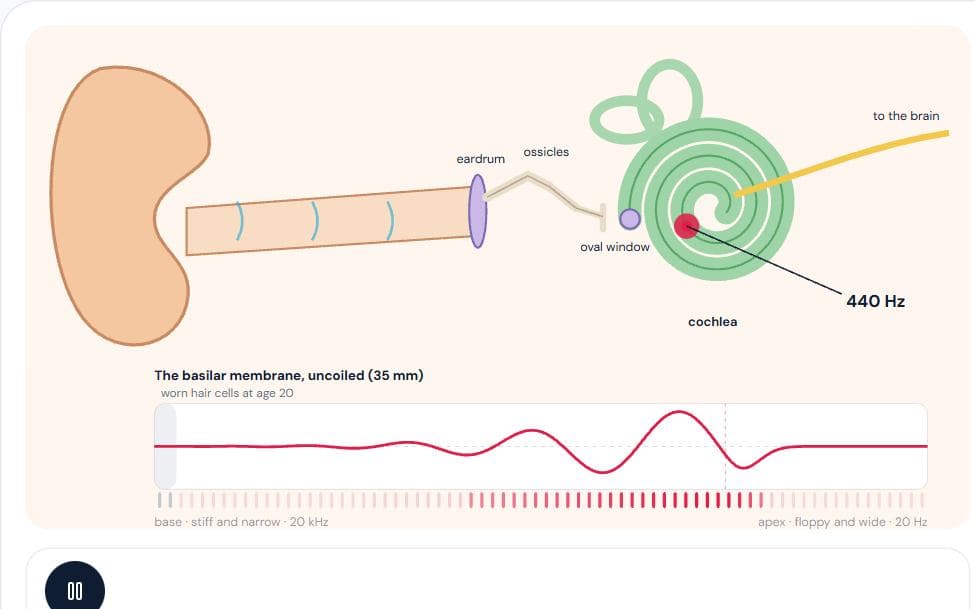
Sweep a tone from 20 Hz to 20 kHz and see where it makes the cochlea's basilar membrane vibrate most: high notes near the oval window, low notes at the apex. Listen, test your own upper limit, and see how it falls with age.

Interactive virtual lab · no download · works on phones and laptops

Chapter
Neural Control and Coordination (the ear) · Sound
For
Class 9 · 11 · NEET
Time
~8 min

The Cochlea & Audible Range is a Pro simulation

Pro opens all 125 virtual labs — 483 simulations with guides and quizzes.

How to use it

  1. 1Drag the frequency slider (or tap a preset) and watch the vibration peak move.
  2. 2Turn on Listen to hear the tone — start with the volume low.
  3. 3Hearing test: raise the frequency until you cannot hear it and press “I can't hear it”.
  4. 4Change the age slider to see the typical upper limit.

What to notice

  • Each pitch makes one place on the basilar membrane vibrate most — the brain reads pitch from where the hair cells fire.
  • High frequencies peak near the base (oval window); low frequencies travel to the apex.
  • Humans hear roughly 20 Hz to 20 kHz; below is infrasound, above is ultrasound.
  • Hair cells at the base wear out first, so the highest notes are the first to go with age.

For teachers

A ready-made teaching kit comes with this lab

  • Lesson plan

    18 min, 4 steps

  • Ask the class

    4 questions with answers

  • Quick quiz

    6 questions, printable

  • Key formulas

    2 formulas

About the Cochlea & Audible Range simulation

The cochlea is the snail-shaped organ of the inner ear that turns sound into nerve signals. Sound makes the basilar membrane inside it vibrate, and each pitch makes one place vibrate most: high frequencies near the base by the oval window, low frequencies near the apex. Hair cells at that place fire, and the brain reads the place as pitch.

In this cochlea and audible range simulation you sweep a tone from 10 Hz to 40 kHz and watch where the uncoiled membrane vibrates, play the tone to test your own upper limit of hearing, change the age to see how high-frequency hearing fades, and compare the hearing ranges of humans, dogs, bats and elephants. It covers the ear in Neural Control and Coordination (Class 11 biology, NEET) and Sound in Class 9.

Also covers: cochlea, ear, hearing, audible frequency, hair cells, basilar membrane, pitch, infrasound, ultrasound, 20 Hz to 20 kHz.

Frequently asked questions

Which part of the cochlea detects high-pitched sounds?

The base, near the oval window, where the basilar membrane is narrow and stiff.

What is the range of human hearing?

About 20 Hz to 20 000 Hz in young people. Below is infrasound, above is ultrasound.

Why do older people lose high-frequency hearing first?

Hair cells at the base of the cochlea, which detect high frequencies, wear out first (presbycusis).

Where are the hair cells of the ear?

In the organ of Corti, on the basilar membrane inside the cochlea.