Skip to content
Mechanics · Physics

Collision Lab Simulation

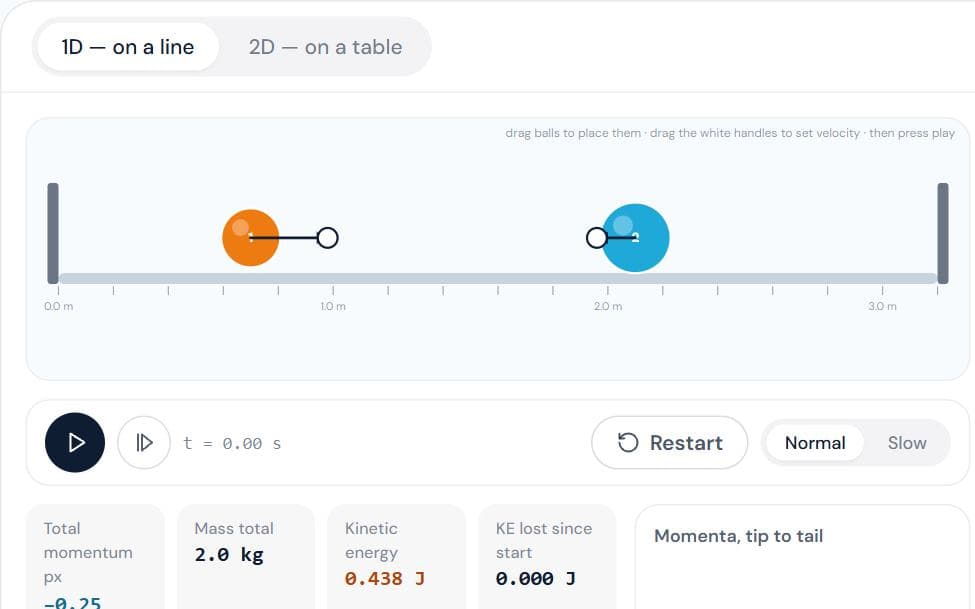
Collide balls in a line or on a table. Change masses, velocities and elasticity, and watch total momentum stay fixed while kinetic energy may not.

Interactive virtual lab · no download · works on phones and laptops

Chapter
Work, Energy and Power · System of Particles
For
Class 11 · JEE · NEET
Time
~15 min

Collision Lab is a Pro simulation

Pro opens all 125 virtual labs — 483 simulations with guides and quizzes.

How to use it

  1. 1Choose 1D or 2D and the number of balls.
  2. 2Drag balls to place them; drag their arrows to set velocity.
  3. 3Set elasticity from 0 % (sticky) to 100 %.
  4. 4Turn on momentum vectors and the centre of mass.

What to notice

  • Total momentum is conserved in every collision.
  • Kinetic energy is conserved only when e = 1 (perfectly elastic).
  • Equal masses in a 1D elastic collision swap velocities.
  • The centre of mass moves at constant velocity throughout.

For teachers

A ready-made teaching kit comes with this lab

  • Lesson plan

    22 min, 4 steps

  • Ask the class

    3 questions with answers

  • Quick quiz

    6 questions, printable

  • Key formulas

    3 formulas

About the Collision Lab simulation

When two objects collide, the total momentum of the pair is conserved as long as no outside force acts. What changes between collisions is kinetic energy: in an elastic collision it is conserved too, in an inelastic one some is turned into heat and sound, and in a perfectly inelastic collision the objects stick together.

This collision lab lets you set masses, velocities and elasticity for balls in one or two dimensions, then watch momentum vectors, the centre of mass and the kinetic energy before and after. It is ideal for Work, Energy and Power and System of Particles (Class 11) and for the collision questions JEE loves — such as why equal masses swap velocities in a head-on elastic collision.

Also covers: momentum, elastic collision, inelastic, coefficient of restitution, kinetic energy, center of mass.
Frequently asked questions

Is momentum conserved in an inelastic collision?

Yes. Momentum is conserved in every collision without external forces; only kinetic energy is lost in an inelastic one.

What happens when equal masses collide elastically head-on?

They exchange velocities: the moving ball stops and the stationary one moves off with its speed — like Newton's cradle.

What does the coefficient of restitution measure?

How bouncy the collision is: e = 1 for elastic, 0 for perfectly inelastic, and in between for real collisions.