Skip to content
Light & Optics · Physics

Colour Vision Simulation

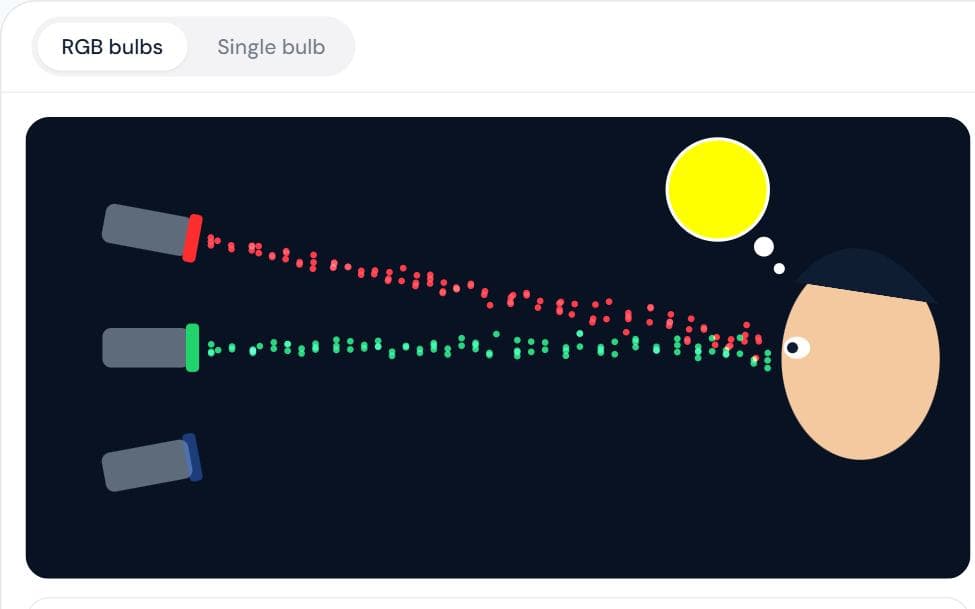
Mix red, green and blue light and see the colour a person perceives. Then pass white or single-colour light through a filter.

Interactive virtual lab · no download · works on phones and laptops

Chapter
Human Eye and the Colourful World
For
Class 10
Time
~8 min

Colour Vision is a Pro simulation

Pro opens all 125 virtual labs — 483 simulations with guides and quizzes.

How to use it

  1. 1RGB: set each lamp's brightness.
  2. 2Single bulb: choose white or a wavelength, then add a filter.
  3. 3Show the light as a beam or as photons.

What to notice

  • Red + green light looks yellow; all three at full brightness look white.
  • A filter passes its own colour and absorbs the rest.
  • A red filter in front of a green beam lets nothing through.

For teachers

A ready-made teaching kit comes with this lab

  • Lesson plan

    18 min, 4 steps

  • Ask the class

    3 questions with answers

  • Quick quiz

    6 questions, printable

  • Key formulas

    1 formulas

About the Colour Vision simulation

We see colour with three kinds of cone cell, most sensitive to red, green and blue light. Mixing those three coloured lights in different amounts can match almost any colour we see — that is additive mixing, and it is how every phone and TV screen works. A filter, by contrast, removes colours from white light rather than adding them.

In this colour vision simulation you shine red, green and blue lamps at a person and see the colour they perceive, then try a single bulb of any wavelength with a filter in the beam. Show the light as a solid beam or as photons. It suits The Human Eye and the Colourful World in Class 10.

Also covers: rgb, additive colour mixing, colour filter, monochromatic light, wavelength, photons.
Frequently asked questions

Why do red and green light make yellow?

Together they stimulate the red- and green-sensitive cones in the same proportion yellow light does, so the brain sees yellow.

What does a red filter do to white light?

It absorbs the other colours and lets only red through.

Why is mixing paint different from mixing light?

Paint mixing is subtractive — each pigment absorbs colours — while light mixing adds them.