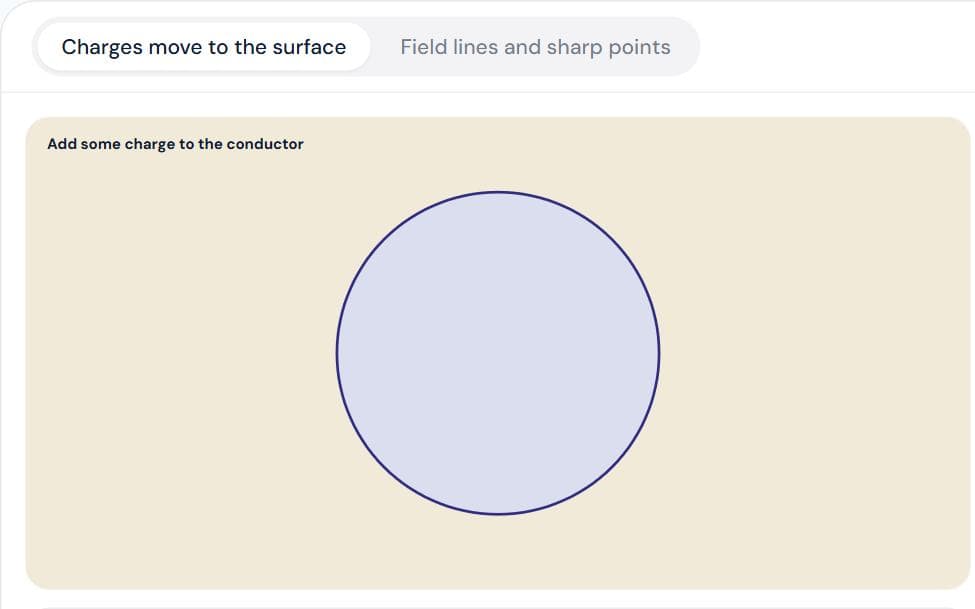
About the Charges and Fields on a Conductor simulation
In a conductor charges are free to move, so any excess charge repels itself out to the outer surface and spreads until the field inside is zero and the whole conductor is at one potential. The surface is then an equipotential, field lines leave it at right angles, and the charge is densest where the surface is most sharply curved — so is the field just outside.
This conductor simulation shows both halves of that story. Add charges inside a conductor and watch them race to the surface, with or without an external field. Then solve for the charge on a sphere, an ellipse, a pointed shape and a box, and see the field lines and equipotentials around them.
Also covers: charge resides on surface, field inside conductor zero, surface charge density sharp point, corona discharge, electrostatic shielding.