About the Conic Constructions Lab simulation
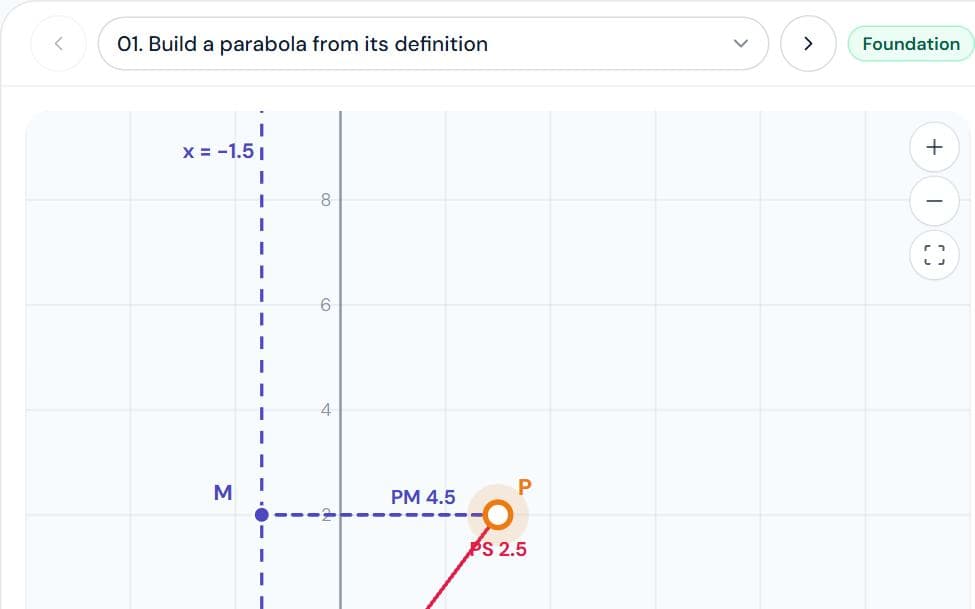
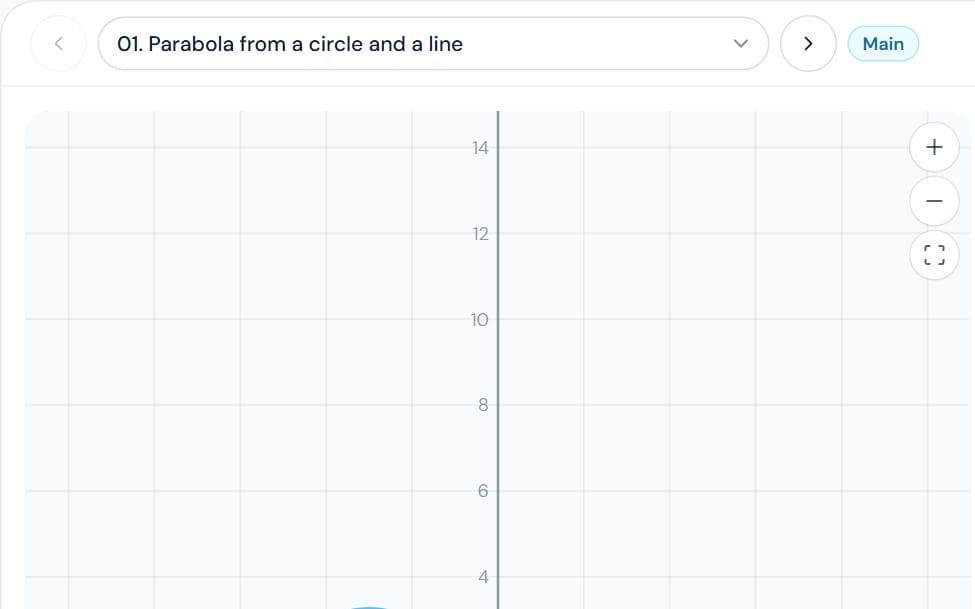
A locus is the path of a point that obeys a rule. Many conics appear as loci of circle centres. If a moving circle touches a fixed circle (centre F, radius R) from outside and also touches a fixed line l, then PF = R + r and the distance from P to l is r, so PF equals the distance from P to the line l′ drawn R beyond l: a parabola with focus F and directrix l′ (not l). A circle inside one fixed circle and outside another gives PF₁ + PF₂ = R₁ + R₂, an ellipse; a circle touching two separate circles gives |PF₁ − PF₂| = |R₁ − R₂|, one branch of a hyperbola, or the perpendicular bisector when the radii are equal.
This Conic Constructions Lab builds each of these on a coordinate board: drag the fixed circles and the line, press Play, and the centre of the moving circle traces its path while the tangencies hold exactly. Tick the theoretical conic to see the trace land on it. Two more modules follow the same idea: a point on a rod sliding between a wall and the floor traces x²/(tL)² + y²/((1 − t)L)² = 1 (the midpoint a quarter circle), and an ellipse defined by perpendicular distances is translated and rotated, showing that its shape never changes while its x, y equation gains an xy term. Every module has Predict, Derive and Practise steps.
Also covers: locus, geometric locus, conic construction, parabola from circle and line, ellipse from two circles, hyperbola from two circles, focus directrix, sliding ladder locus, falling rod ellipse, rotation of ellipse, translation of axes, xy term, circle tangency locus.