Skip to content
Mechanics · Physics

Connected Bodies: Pulleys & Blocks Simulation

Solve five classic set-ups by watching them move: blocks in contact, blocks on a string, the Atwood machine, a table with a hanging mass, and stacked blocks. Every force on every body is drawn, with the acceleration and tension worked out.

Interactive virtual lab · no download · works on phones and laptops

Chapter
Laws of Motion (NLM)
For
Class 11 · JEE · NEET
Time
~20 min

Connected Bodies: Pulleys & Blocks is a Pro simulation

Pro opens all 125 virtual labs — 483 simulations with guides and quizzes.

How to use it

  1. 1Pick a set-up from the tabs.
  2. 2Change the masses, force and friction.
  3. 3Press play to let it move from rest.

What to notice

  • A system moving together has one acceleration: a = net external force / total mass.
  • The contact force or tension only has to accelerate the part beyond it.
  • Atwood: a = (m₂ − m₁)g/(m₁ + m₂), and T lies between the two weights.
  • The top block of a stack slips once the needed friction m₂a exceeds μₛm₂g.

For teachers

A ready-made teaching kit comes with this lab

  • Lesson plan

    25 min, 4 steps

  • Ask the class

    3 questions with answers

  • Quick quiz

    6 questions, printable

  • Key formulas

    3 formulas

About the Connected Bodies: Pulleys & Blocks simulation

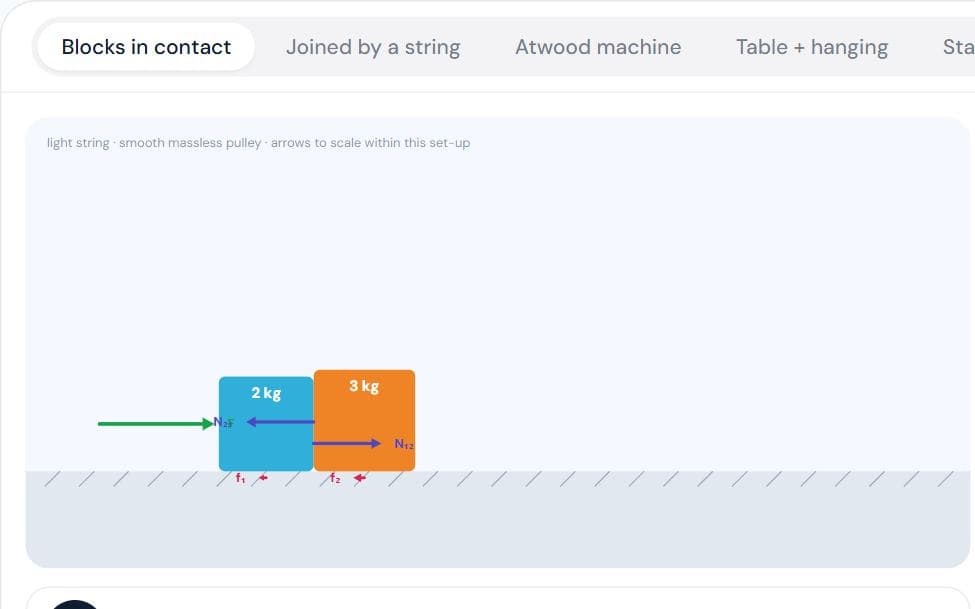
When bodies are joined by a light string or pushed together, they move with one acceleration. The quick method: treat the whole system as one body to get a = (net external force)/(total mass), then look at one body on its own to find the internal force — the tension or the contact force — that gives it that acceleration.

This connected bodies simulation solves five set-ups that cover most laws-of-motion problems: blocks in contact, blocks joined by a string, the Atwood machine, a block on a table pulled by a hanging mass, and one block stacked on another. Each body carries its own force arrows (its free-body diagram), and the readouts give the acceleration, tension, contact force and friction, with the conditions for motion or slipping.

Also covers: atwood machine, blocks in contact, contact force, tension in string, two blocks connected by string, block on table hanging mass, stacked blocks friction, pulley problems, nlm problems jee.
Frequently asked questions

How do you find the tension in a string connecting two blocks?

First find the common acceleration from the whole system, then apply F = ma to the block behind the string: the tension is what accelerates it (plus its friction).

Why is the tension in an Atwood machine less than the heavier weight?

The heavier mass accelerates downwards, so the net force on it is downwards: its weight must be more than the tension. The lighter mass accelerates up, so the tension is more than its weight.

When does the top block of a stack start slipping?

Friction is the only horizontal force on the top block, so it can give it at most μₛg. Once the system's acceleration would exceed μₛg, the top block slips back relative to the lower one.