Skip to content
Electricity · Physics

Coulomb's Law Simulation

Two charges push or pull. Change their sizes, signs and separation and watch F = kq₁q₂/r² — the same inverse-square form as gravity, but able to repel.

Interactive virtual lab · no download · works on phones and laptops

Chapter
Electric Charges and Fields
For
Class 12 · JEE · NEET
Time
~8 min

Coulomb's Law is a Pro simulation

Pro opens all 125 virtual labs — 483 simulations with guides and quizzes.

How to use it

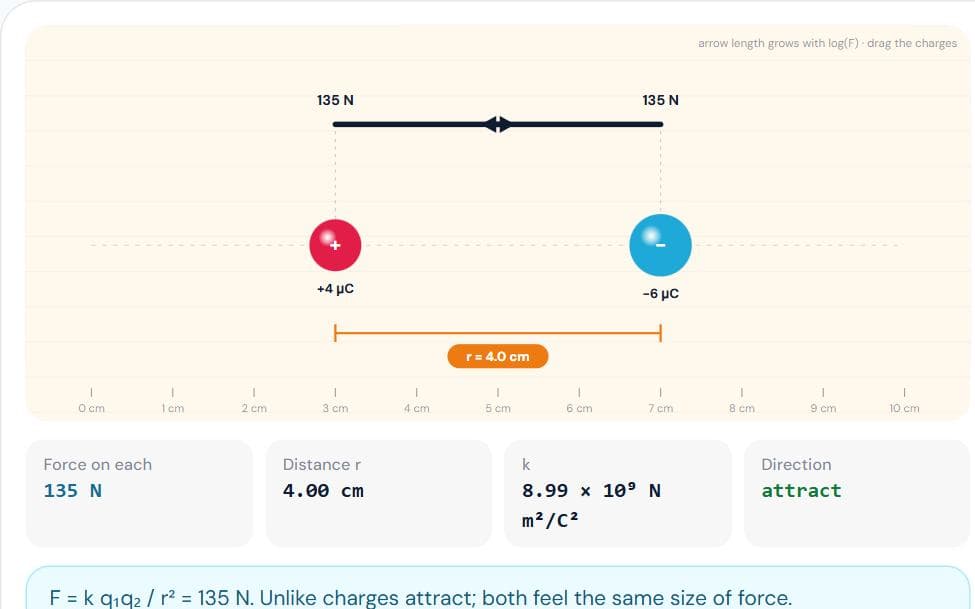
  1. 1Drag the charges to change the distance.
  2. 2Set each charge with its slider (negative to positive).
  3. 3Switch between the macro scale (μC, cm) and the atomic scale (e, pm).

What to notice

  • Like charges repel, unlike charges attract.
  • The force falls as 1/r²: half the distance → four times the force.
  • Both charges feel equal and opposite forces.
  • k = 8.99 × 10⁹ N m²/C² — electric forces dwarf gravity.

For teachers

A ready-made teaching kit comes with this lab

  • Lesson plan

    18 min, 4 steps

  • Ask the class

    3 questions with answers

  • Quick quiz

    6 questions, printable

  • Key formulas

    2 formulas

About the Coulomb's Law simulation

Coulomb's law gives the force between two point charges: proportional to the product of the charges and inversely proportional to the square of the distance between them. Like charges repel and unlike charges attract, and the forces on the two charges are always equal and opposite.

In this Coulomb's law simulation you set two charges in microcoulombs, drag them apart along a ruler, and read the force arrows and their values. It covers Electric Charges and Fields in Class 12, JEE and NEET.

Also covers: electrostatic force, point charges, inverse square law, attraction repulsion.
Frequently asked questions

What happens to the force if the distance is halved?

It becomes four times as large, since F ∝ 1/r².

What happens if one charge is doubled?

The force doubles — on both charges, since they always feel equal and opposite forces.

How does a medium change the force?

It divides it by the dielectric constant K of the medium; in water (K ≈ 80) the force is about 80 times weaker.