Skip to content
Mechanics · Physics

Cycloid: Isochrone and Brachistochrone Simulation

Release beads from different heights on a cycloid and see them reach the bottom together, then race four tracks. Find out which path is the quickest way down.

Interactive virtual lab · no download · works on phones and laptops

Chapter
Work, Energy and Power · Oscillations
For
Class 11 · JEE
Time
~10 min

Cycloid: Isochrone and Brachistochrone is a Pro simulation

Pro opens all 125 virtual labs — 483 simulations with guides and quizzes.

How to use it

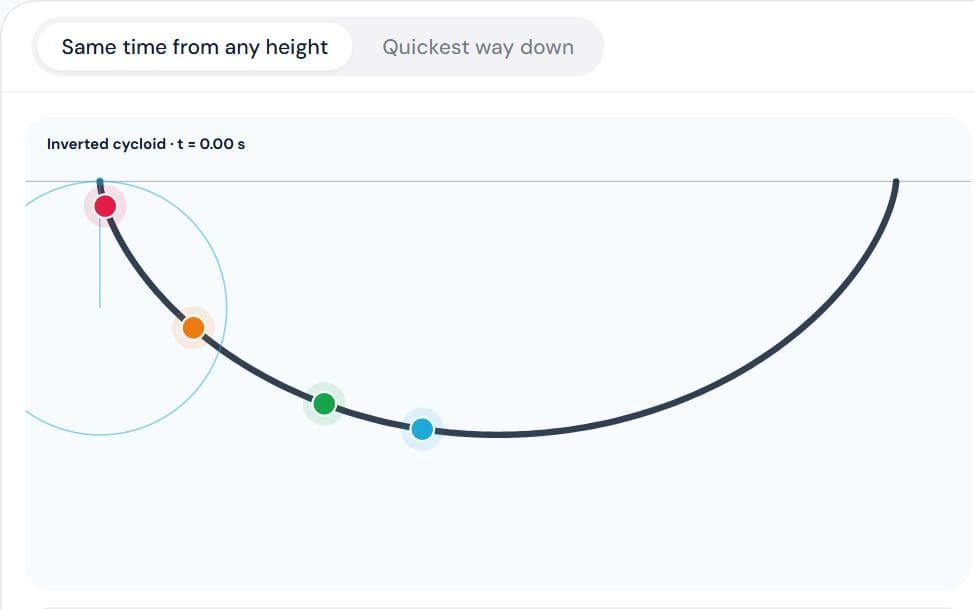
  1. 1Isochrone: drag the four beads to any heights and release.
  2. 2Switch to a circular bowl to compare.
  3. 3Race: drag B and press Race.
  4. 4Read each track's time.

What to notice

  • On a cycloid every release reaches the bottom after π√(r/g).
  • The motion along a cycloid is exactly simple harmonic.
  • A circular bowl is only isochronous for small swings.
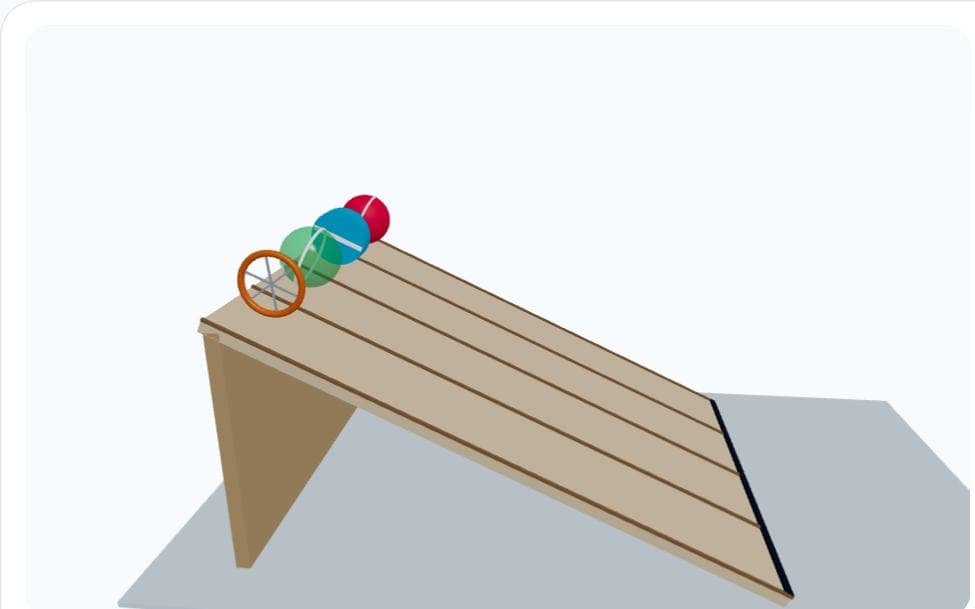
  • The cycloid beats the straight line, though the line is shorter.

For teachers

A ready-made teaching kit comes with this lab

  • Lesson plan

    18 min, 4 steps

  • Ask the class

    3 questions with answers

  • Quick quiz

    5 questions, printable

  • Key formulas

    3 formulas

About the Cycloid: Isochrone and Brachistochrone simulation

The cycloid is the curve traced by a point on the rim of a rolling wheel. Turned upside down it answers two famous questions. Huygens found it is the isochrone: a bead sliding on it reaches the bottom in the same time π√(r/g) from any starting height, because the force along the curve is exactly proportional to the distance from the bottom. Johann Bernoulli showed it is also the brachistochrone: the quickest frictionless path between two points.

In this cycloid simulation you release beads from four heights and watch them arrive together, then compare a circular bowl, which only nearly manages it. In the race tab, drag the end point and race a straight line, a parabola, a circular arc and a cycloid.

Also covers: brachistochrone, tautochrone, isochrone curve, fastest path, cycloid pendulum.
Frequently asked questions

What is the brachistochrone problem?

Finding the curve along which a bead slides from one point to a lower one in the least time. The answer is a cycloid, not the straight line.

Why is the cycloid isochronous?

Along it the slope at arc length s from the bottom is s/4r, so the restoring force is proportional to s: simple harmonic motion with a period independent of amplitude.

Is a simple pendulum isochronous?

Only for small swings. For larger amplitudes its period grows; a pendulum whose bob moves on a cycloid is exactly isochronous.