Skip to content
Magnetism · Physics

Earth's Magnetic Field Simulation

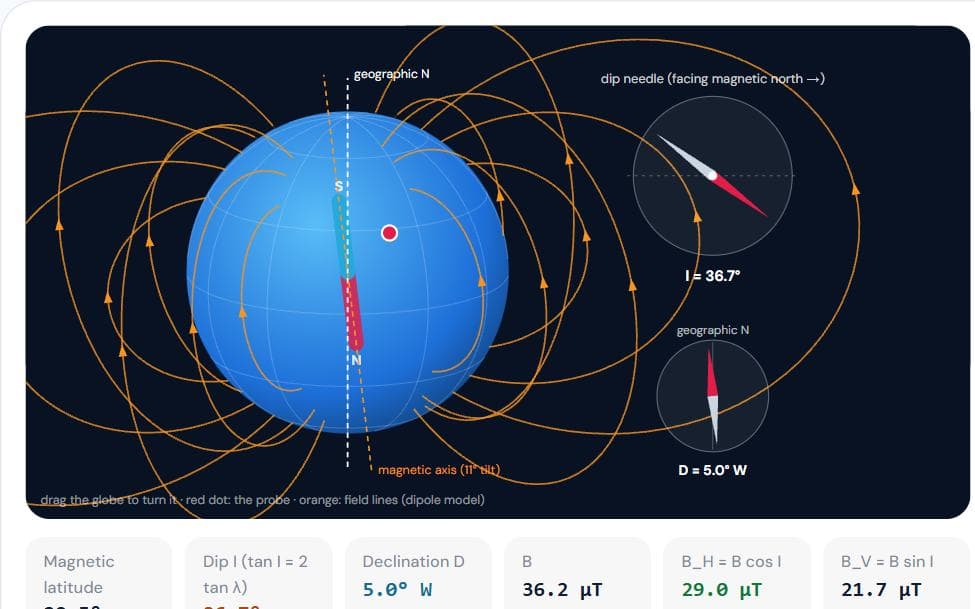
Turn a 3D Earth with its magnetic field lines and see why a compass points north. Move a dip needle from the equator to the poles, read the angle of dip, declination and the horizontal and vertical components, and compare places such as Delhi and Chennai.

Interactive virtual lab · no download · works on phones and laptops

Chapter
Magnetism and Matter
For
Class 10 · Class 12 · JEE · NEET
Time
~10 min

Earth's Magnetic Field is a Pro simulation

Pro opens all 125 virtual labs — 483 simulations with guides and quizzes.

How to use it

  1. 1Drag the globe to turn it; switch field lines, axes and the equator on and off.
  2. 2Drag the probe (or pick a city) to change the latitude and longitude.
  3. 3Read the dip, declination, B, B_H and B_V for that place.
  4. 4Watch the dip needle and the compass at the probe.

What to notice

  • The Earth behaves like a giant bar magnet whose south pole lies near the geographic North Pole.
  • The magnetic axis is tilted about 11° from the rotation axis, so magnetic and geographic north differ (declination).
  • A dip needle is horizontal at the magnetic equator and vertical at the magnetic poles; tan I = 2 tan λ.
  • B_H = B cos I and B_V = B sin I, so tan I = B_V / B_H.

For teachers

A ready-made teaching kit comes with this lab

  • Lesson plan

    19 min, 4 steps

  • Ask the class

    4 questions with answers

  • Quick quiz

    6 questions, printable

  • Key formulas

    3 formulas

About the Earth's Magnetic Field simulation

The Earth behaves as if a huge bar magnet sat inside it, tilted about 11° from its spin axis, with its south pole under the Arctic — which is why the north end of a compass points north. The field is described at any place by three elements: the declination (the angle between true north and magnetic north), the angle of dip (how steeply the field points into the ground), and the horizontal component B_H.

This Earth's magnetic field simulation shows a 3D globe you can turn, with field lines, the magnetic axis and the bar magnet inside. Move a probe to any latitude and longitude — or pick Delhi, Mumbai, Chennai or London — and read the dip, declination, total field and its horizontal and vertical components, with a dip needle and compass for that place. It covers Magnetism and Matter in Class 12 and the Earth's magnetism questions in JEE and NEET.

Also covers: earth's magnetic field, geomagnetism, angle of dip, inclination, declination, magnetic meridian, horizontal component, dip circle, magnetic poles, earth as a magnet.
Frequently asked questions

What is the angle of dip at the magnetic equator and at the poles?

0° at the magnetic equator, where the field is horizontal, and 90° at the magnetic poles, where it is vertical.

Why does a compass not work well near the magnetic poles?

The field there is almost vertical, so its horizontal component — the part that turns a compass — is nearly zero.

What is magnetic declination?

The angle between geographic (true) north and the direction a compass points, at a given place.

Which magnetic pole of the Earth lies near the geographic North Pole?

A magnetic south pole: it attracts the north end of a compass needle.