Skip to content
Electricity · Physics

Electron Flow vs Conventional Current Simulation

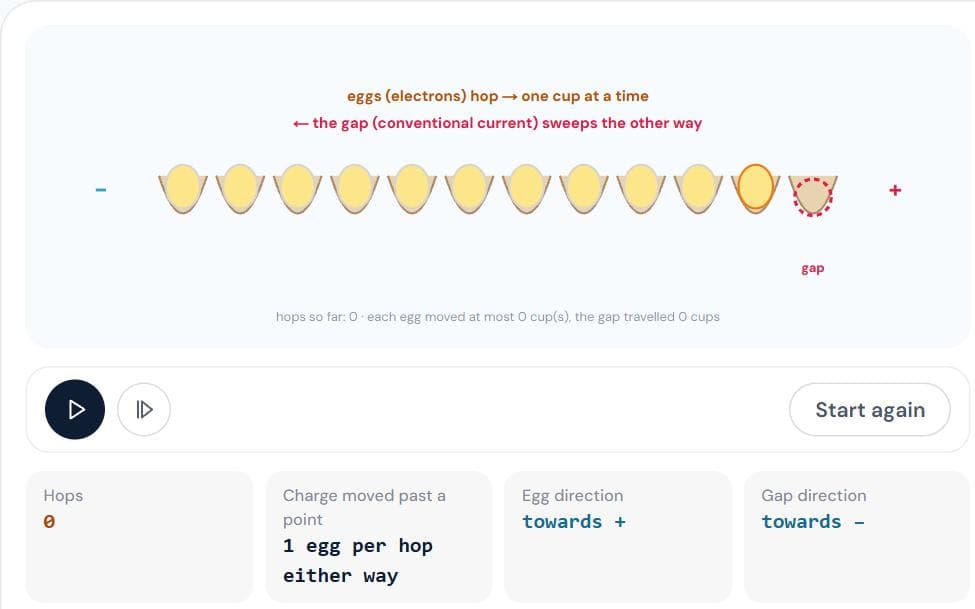
An egg carton with one empty cup: each egg hops one cup, while the gap sweeps across the whole carton the other way. Electrons are the eggs; conventional current is the gap's bookkeeping — the same current described the other way round.

Interactive virtual lab · no download · works on phones and laptops

Chapter
Current Electricity
For
Class 8–12
Time
~8 min

Electron Flow vs Conventional Current is a Pro simulation

Pro opens all 125 virtual labs — 483 simulations with guides and quizzes.

How to use it

  1. 1Press play or step one hop at a time.
  2. 2Watch the eggs, the gap, or both.

What to notice

  • Each egg moves one cup; the gap crosses the carton.
  • The gap always moves opposite to the eggs.
  • Flipping both sign and direction leaves the current unchanged.

For teachers

A ready-made teaching kit comes with this lab

  • Lesson plan

    17 min, 4 steps

  • Ask the class

    3 questions with answers

  • Quick quiz

    5 questions, printable

  • Key formulas

    1 formulas

About the Electron Flow vs Conventional Current simulation

Electrons in a wire drift from the negative terminal to the positive one, yet circuit diagrams show current flowing the other way. This simulation explains why both descriptions are right using an egg carton with one empty cup. Each step, the egg next to the gap hops into it: every egg moves just one cup one way, while the gap marches across the whole carton the other way.

Nothing physical moves with the gap — it is bookkeeping. In the same way, conventional current describes positive charge moving from + to −: flipping both the sign of the carrier and its direction leaves the current unchanged. Circuit theory adopted that convention before the electron was discovered.

Also covers: conventional current, electron flow, direction of current, egg carton analogy, hole movement, drift.
Frequently asked questions

Which way do electrons flow in a circuit?

From the negative terminal, through the circuit, to the positive terminal — opposite to the conventional current arrows.

Why do we use conventional current?

It was defined (as positive charge flow) before the electron was discovered; since reversing both sign and direction gives the same current, every law works either way.

Do electrons in a wire move fast?

No. Their drift speed is typically a fraction of a millimetre per second — like each egg moving only one cup — even though the signal travels almost instantly.