Skip to content
Light & Optics · Physics

Electromagnetic Waves Simulation

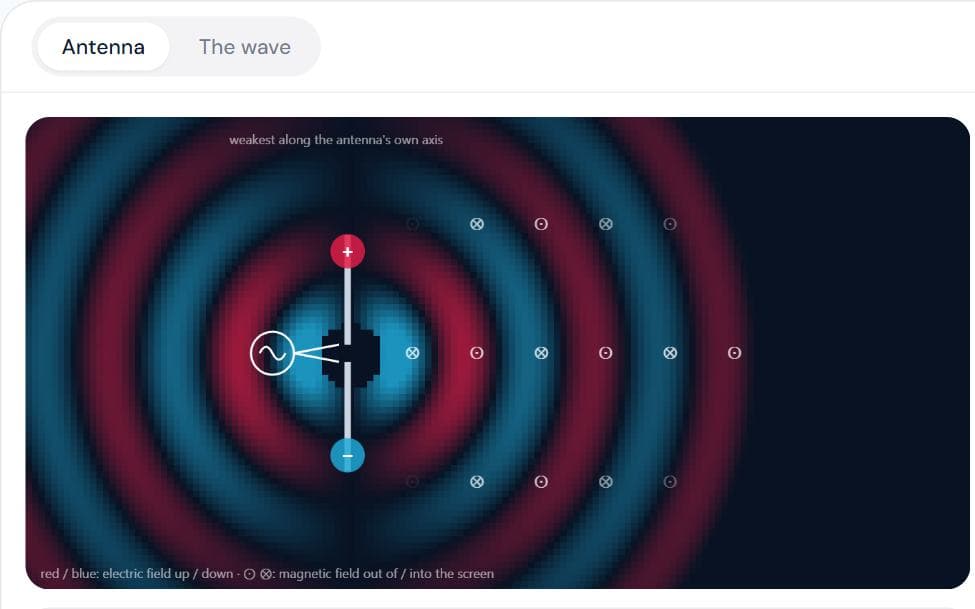
An oscillating charge in an antenna sends out electromagnetic waves. Watch the electric and magnetic fields travel outwards together, at right angles to each other and to the direction of travel, then sweep the frequency across the whole spectrum from radio to gamma rays.

Interactive virtual lab · no download · works on phones and laptops

Chapter
Electromagnetic Waves
For
Class 12 · JEE · NEET
Time
~10 min

Electromagnetic Waves is a Pro simulation

Pro opens all 125 virtual labs — 483 simulations with guides and quizzes.

How to use it

  1. 1Antenna: change the driving frequency and watch the field spread out from the antenna.
  2. 2The wave: turn the 3D view and show E, B or both.
  3. 3Slide the frequency (or wavelength) to move through the spectrum.
  4. 4Read c = fλ and E₀ = cB₀ in the panel.

What to notice

  • Only an accelerating charge radiates: no oscillation, no wave.
  • E and B oscillate in phase, at right angles to each other and to the direction of travel: a transverse wave.
  • Every EM wave travels at c = 3 × 10⁸ m/s in vacuum, and c = fλ; E₀ = c B₀.
  • Radio, microwaves, infrared, light, UV, X-rays and gamma rays differ only in frequency.

For teachers

A ready-made teaching kit comes with this lab

  • Lesson plan

    19 min, 4 steps

  • Ask the class

    4 questions with answers

  • Quick quiz

    6 questions, printable

  • Key formulas

    3 formulas

About the Electromagnetic Waves simulation

An electromagnetic wave is a travelling pattern of electric and magnetic fields, made whenever a charge accelerates — for example the electrons sloshing up and down a radio antenna. The two fields oscillate in step, at right angles to each other and to the direction the wave travels, so EM waves are transverse. In vacuum they all travel at c = 3 × 10⁸ m/s.

This electromagnetic wave simulation shows an antenna radiating, with its electric field spreading out (and none along the antenna's own axis), and a 3D view of a plane wave you can turn. Slide the frequency across sixteen decades, from radio waves through microwaves, infrared, light and ultraviolet to X-rays and gamma rays, and read λ = c/f, B₀ = E₀/c and the intensity. It covers Electromagnetic Waves in Class 12, JEE and NEET.

Also covers: electromagnetic wave, EM wave, oscillating charge, antenna, electric and magnetic field, electromagnetic spectrum, speed of light, radio waves, transverse wave.
Frequently asked questions

What produces electromagnetic waves?

Accelerating charges. A charge at rest or moving at constant velocity doesn't radiate.

Are electromagnetic waves transverse or longitudinal?

Transverse: E and B are both perpendicular to the direction of travel and to each other.

What is the wavelength of a 100 MHz radio wave?

λ = c/f = 3 × 10⁸ / 10⁸ = 3 m.

Do X-rays travel faster than radio waves?

No. In vacuum every EM wave travels at c; they differ only in frequency and wavelength.