Skip to content
Mechanics · Physics

Explosion and Centre of Mass Simulation

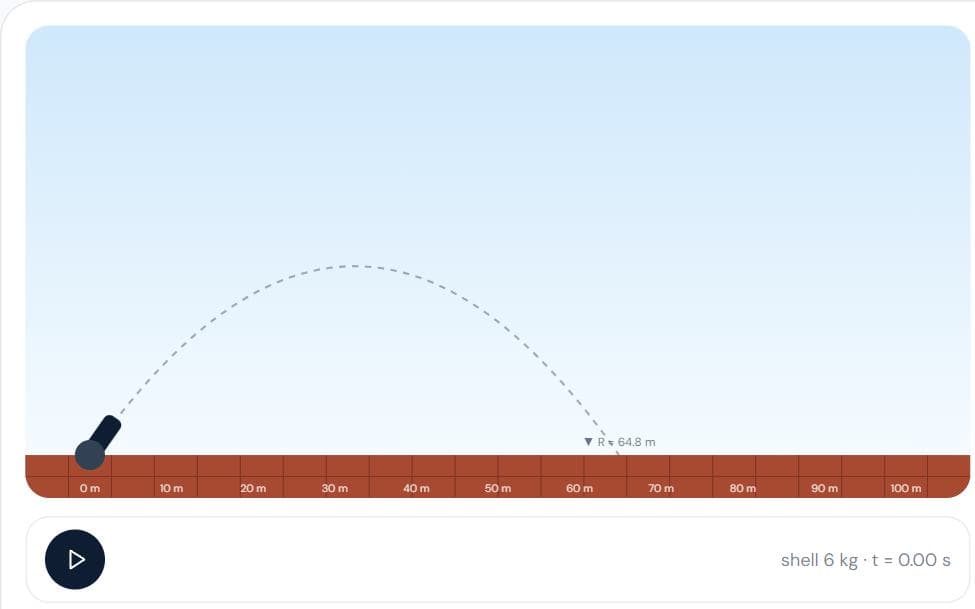
Fire a shell that bursts into fragments in mid-air and watch its centre of mass carry on along the same parabola. Compare momentum before and after the explosion.

Interactive virtual lab · no download · works on phones and laptops

Chapter
System of Particles and Rotational Motion
For
Class 11 · JEE · NEET
Time
~10 min

Explosion and Centre of Mass is a Pro simulation

Pro opens all 125 virtual labs — 483 simulations with guides and quizzes.

How to use it

  1. 1Set the launch speed and angle, then Fire.
  2. 2Choose when it bursts and how it splits.
  3. 3Turn on momentum arrows and the centre of mass.
  4. 4Try 'Half stops dead' for the classic JEE problem.

What to notice

  • An explosion is an internal force: total momentum does not change.
  • The centre of mass follows the original parabola.
  • If half stops dead at the top, the other half lands at 3R/2.
  • Once a fragment lands, the ground acts and the centre of mass leaves the parabola.

For teachers

A ready-made teaching kit comes with this lab

  • Lesson plan

    18 min, 4 steps

  • Ask the class

    3 questions with answers

  • Quick quiz

    5 questions, printable

  • Key formulas

    3 formulas

About the Explosion and Centre of Mass simulation

When a shell explodes in mid-air, the forces that tear it apart are internal: they act in equal and opposite pairs between the fragments. So the total momentum of the fragments is the same just after the burst as just before, and the centre of mass carries on along the parabola the whole shell would have followed, as if nothing had happened.

This explosion simulation fires a shell that bursts at the top of its flight or whenever you press the button. Choose random fragments with a chosen energy release, or the classic JEE case where one half stops dead. Momentum arrows and the centre of mass are drawn throughout, and you can see the moment a fragment lands and the centre of mass leaves the parabola.

Also covers: conservation of momentum, projectile explodes, centre of mass motion, internal forces, shell bursts.
Frequently asked questions

Does the centre of mass change its path when a projectile explodes?

No — the explosion is internal, so the centre of mass keeps moving along the original parabola until some fragment hits the ground.

A projectile breaks into two equal parts at the top; one falls vertically. Where does the other land?

The centre of mass lands at the range R, and the first part lands at R/2, so the other lands at 3R/2 from the launch point.

Is kinetic energy conserved in an explosion?

No. Chemical energy is converted to kinetic energy, so the fragments have more kinetic energy than the shell had; only momentum is conserved.