Skip to content
Mechanics · Physics

Forces & Motion Simulation

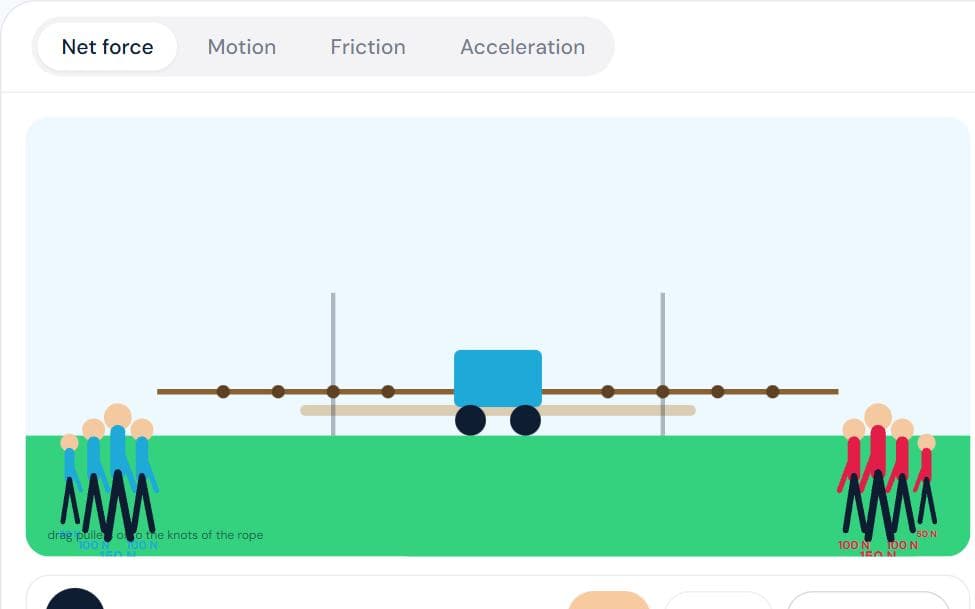
Play tug of war, then push a crate, a fridge and a person across the floor. Balance and unbalance the forces, add friction, and see F = ma.

Interactive virtual lab · no download · works on phones and laptops

Chapter
Laws of Motion
For
Class 9 · Class 11
Time
~12 min

Forces & Motion is a Pro simulation

Pro opens all 125 virtual labs — 483 simulations with guides and quizzes.

How to use it

  1. 1Net force: drag pullers onto the rope, then press Go.
  2. 2Motion: drag the force slider or push with the arrows.
  3. 3Friction: change the friction and watch it oppose the push.
  4. 4Acceleration: read a, v and the forces.

What to notice

  • Balanced forces → no change in motion.
  • The net force points the way the speed changes.
  • Friction opposes sliding; static friction can be larger than kinetic.
  • Same force, twice the mass → half the acceleration.

For teachers

A ready-made teaching kit comes with this lab

  • Lesson plan

    21 min, 4 steps

  • Ask the class

    3 questions with answers

  • Quick quiz

    7 questions, printable

  • Key formulas

    2 formulas

About the Forces & Motion simulation

Newton's laws connect force and motion: an object keeps its velocity unless a net force acts, and the net force equals mass times acceleration. Balanced forces mean no change in motion — not no motion. Friction is one of those forces, and it acts against sliding.

In this forces and motion simulation you push crates, fridges and people with an applied force, switch friction on or off, and see the force arrows, net force, acceleration and speed. A tug-of-war screen shows balanced and unbalanced forces. It suits Force and Laws of Motion in Class 9 and Laws of Motion in Class 11.

Also covers: net force, newton's laws, tug of war, friction, acceleration, f = ma, balanced forces.

Frequently asked questions

If the forces on an object are balanced, does it stop?

No. Balanced forces mean zero acceleration — an object already moving keeps moving at constant velocity (Newton's first law).

Why is it harder to start pushing a box than to keep it moving?

Static friction can be larger than kinetic friction, so you must overcome the larger force to get the box moving.

What happens if you double the force on the same mass?

The acceleration doubles, because a = F/m.