Skip to content
Magnetism · Physics

Moving-Coil Galvanometer Simulation

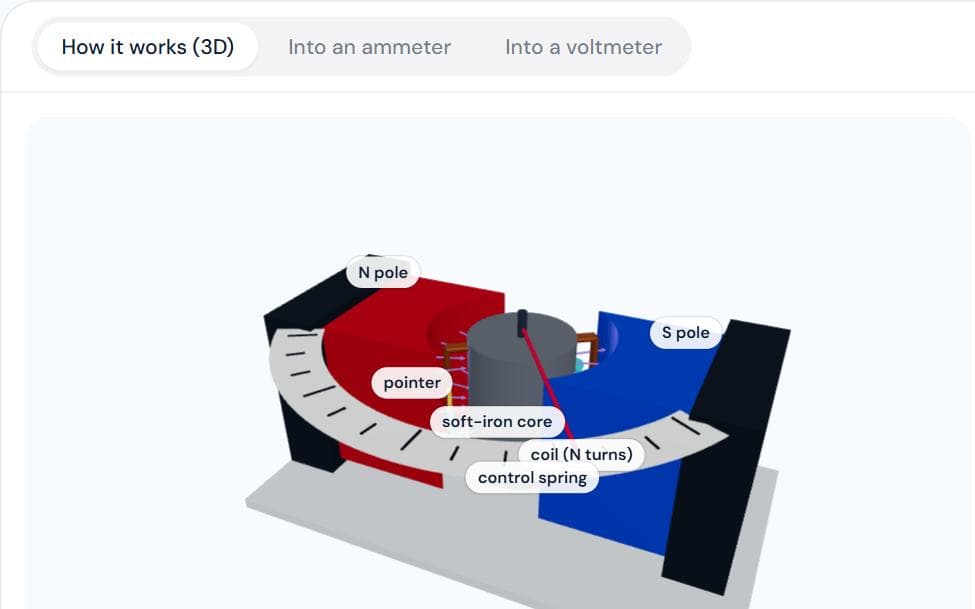
Turn a 3D moving-coil galvanometer with its coil, magnets, core and spring, then convert it into an ammeter and a voltmeter. Work out each shunt and series resistance.

Interactive virtual lab · no download · works on phones and laptops

Chapter
Moving Charges and Magnetism
For
Class 12 · JEE · NEET
Time
~15 min

Moving-Coil Galvanometer is a Pro simulation

Pro opens all 125 virtual labs — 483 simulations with guides and quizzes.

How to use it

  1. 1Drag to turn the 3D galvanometer and change the current.
  2. 2Change turns, field, area and spring.
  3. 3Ammeter and voltmeter tabs: choose the range.
  4. 4Step through the explanation.

What to notice

  • A radial field makes the torque NIAB at every angle: a linear scale.
  • φ = (NAB/k) I; current sensitivity is NAB/k.
  • Ammeter: a small shunt in parallel, S = IgG/(I − Ig).
  • Voltmeter: a large resistance in series, R = V/Ig − G.

For teachers

A ready-made teaching kit comes with this lab

  • Lesson plan

    21 min, 4 steps

  • Ask the class

    3 questions with answers

  • Quick quiz

    5 questions, printable

  • Key formulas

    3 formulas

About the Moving-Coil Galvanometer simulation

A moving-coil galvanometer is a coil of fine wire hung between curved magnet poles around a soft iron core. The poles and core make the field radial, so the coil's sides always cross it at right angles and the torque on the coil is NIAB at every angle. A spring twists back, and the coil settles at an angle proportional to the current — giving a linear scale.

This galvanometer simulation has a 3D model you can turn, with the current, forces and field shown, and two tabs that convert it into the meters you use in the lab: an ammeter (a small shunt in parallel) and a voltmeter (a large resistance in series), stepping through why each works.

Also covers: moving coil galvanometer, radial magnetic field, current sensitivity, galvanometer to ammeter, galvanometer to voltmeter, shunt resistance.
Frequently asked questions

Why is the magnetic field radial in a moving-coil galvanometer?

So that the plane of the coil always lies along the field, making the torque NIAB the same at every deflection and the scale linear.

How is a galvanometer converted into an ammeter?

By connecting a low resistance (shunt) S = IgG/(I − Ig) in parallel, so most of the current bypasses the coil.

How is a galvanometer converted into a voltmeter?

By connecting a high resistance R = V/Ig − G in series, so full-scale deflection occurs at the desired voltage.