Skip to content
Electricity · Physics

Gauss's Law Simulation

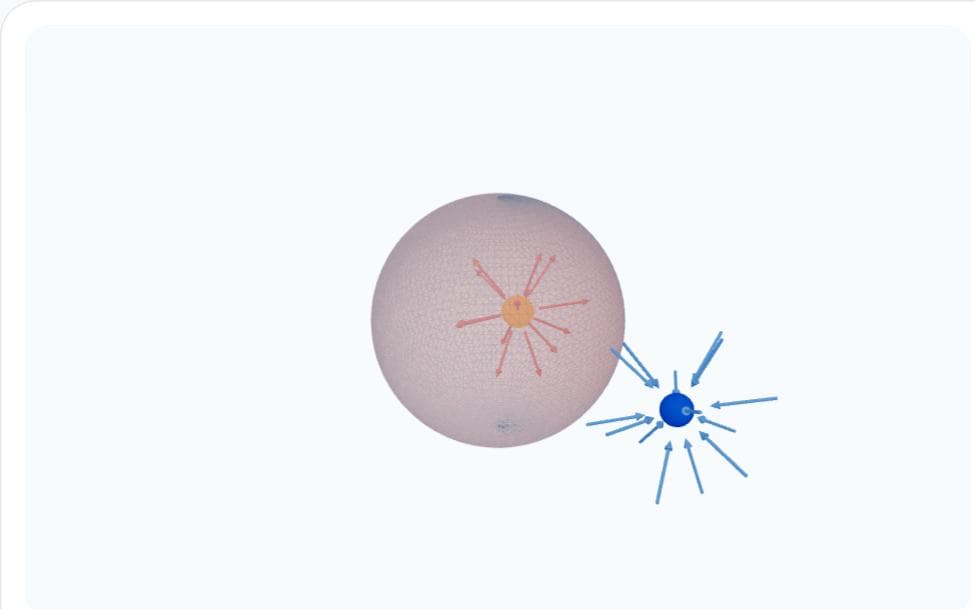
Point charges and a sphere, cylinder or irregular blob in 3D. The flux is integrated numerically over the surface — and always equals q_enclosed/ε₀, whatever the shape. Charges outside add nothing: their field enters and leaves.

Interactive virtual lab · no download · works on phones and laptops

Chapter
Electric Charges and Fields
For
Class 12 · JEE
Time
~15 min

Gauss's Law is a Pro simulation

Pro opens all 125 virtual labs — 483 simulations with guides and quizzes.

How to use it

  1. 1Choose the surface and its size; slide it along x.
  2. 2Select a charge, change its value and position, or remove it.
  3. 3Compare the integrated flux with q/ε₀.

What to notice

  • Flux depends only on the enclosed charge.
  • Size and shape of the surface do not matter.
  • Outside charges contribute zero net flux.

For teachers

A ready-made teaching kit comes with this lab

  • Lesson plan

    21 min, 4 steps

  • Ask the class

    3 questions with answers

  • Quick quiz

    5 questions, printable

  • Key formulas

    1 formulas

About the Gauss's Law simulation

Gauss's law says the electric flux through any closed surface equals the charge enclosed divided by ε₀. In this simulation the flux is not taken from the law — it is computed by adding up E·n dA over thousands of small patches of a sphere, a can-shaped cylinder or a lumpy irregular surface, so you can test the law yourself.

Change the surface's shape and size: the flux stays the same while the same charge is inside. Move a charge outside: its field lines enter on one side (blue) and leave on the other (red), and its net contribution is zero. That is why, for calculations, you choose a surface matching the symmetry — then E can be pulled out of the integral.

Also covers: gauss's law, electric flux, gaussian surface, q enclosed by epsilon0, flux through closed surface.
Frequently asked questions

Does the flux depend on the size of the Gaussian surface?

No. Only on the charge enclosed. A larger sphere has more area but a weaker field at its surface, and the two effects cancel exactly.

Why do charges outside the surface contribute zero flux?

Every field line from an outside charge that enters the surface also leaves it, so the inward and outward flux cancel.

If the flux through a surface is zero, is the field zero on it?

Not necessarily — it only means the net enclosed charge is zero. The field can be large while the inward and outward flux cancel.