Skip to content
Light & Optics · Physics

Lenses & Mirrors Simulation

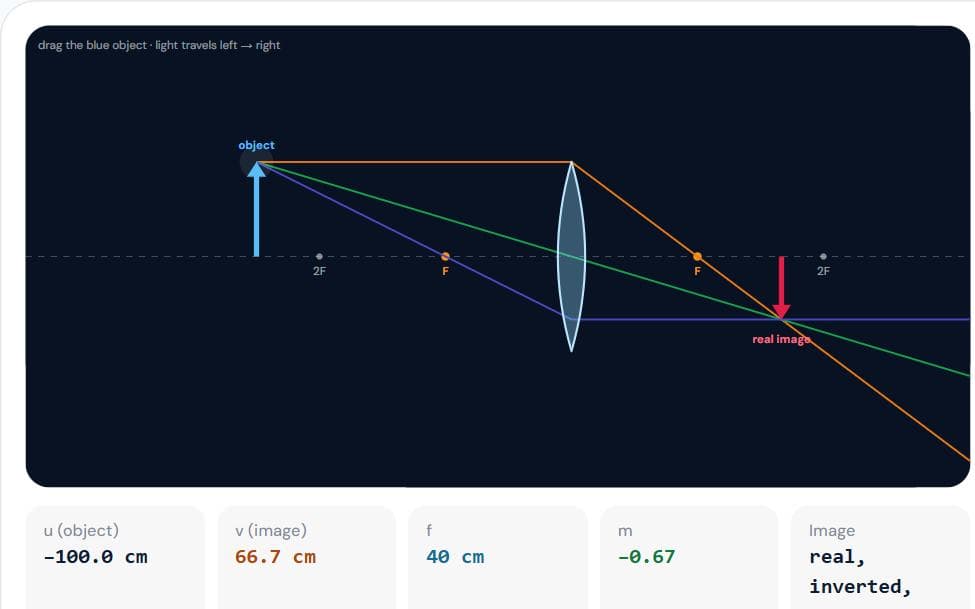
Move an object in front of a convex or concave lens or mirror and watch the principal rays find the image. Read u, v, f and the magnification as you move.

Interactive virtual lab · no download · works on phones and laptops

Chapter
Ray Optics
For
Class 10 · Class 12 · NEET
Time
~15 min

Lenses & Mirrors is a Pro simulation

Pro opens all 125 virtual labs — 483 simulations with guides and quizzes.

How to use it

  1. 1Choose lens or mirror, converging or diverging.
  2. 2Drag the object (the arrow) along the axis.
  3. 3Change the focal length.
  4. 4Switch between principal rays, many rays and no rays.

What to notice

  • 1/v − 1/u = 1/f for a lens; 1/v + 1/u = 1/f for a mirror.
  • An object inside the focal length of a convex lens gives a virtual, upright, enlarged image.
  • A concave lens and a convex mirror always give virtual, upright, smaller images.
  • Magnification m = v/u (lens) — a negative m means inverted.

For teachers

A ready-made teaching kit comes with this lab

  • Lesson plan

    23 min, 4 steps

  • Ask the class

    3 questions with answers

  • Quick quiz

    7 questions, printable

  • Key formulas

    4 formulas

About the Lenses & Mirrors simulation

Lenses and mirrors form images by bending or reflecting rays. A few principal rays — through the centre, parallel to the axis, through the focus — are enough to find where the image forms, whether it is real or virtual, upright or inverted, and how big it is. The lens and mirror formulas give the same answers in numbers.

In this lenses and mirrors simulation you choose a convex or concave lens, a concave, convex or plane mirror, move the object and change the focal length, and draw principal rays or many rays. Read u, v and the magnification as you go. It covers Light – Reflection and Refraction in Class 10 and Ray Optics in Class 12, JEE and NEET.

Also covers: geometric optics, ray diagram, convex lens, concave mirror, focal length, image formation, magnification.
Frequently asked questions

Where is the image when the object is at 2F of a convex lens?

At 2F on the other side: real, inverted and the same size.

When does a convex lens form a virtual image?

When the object is closer than the focus — it then acts as a magnifying glass.

Why does a convex mirror always give a small upright image?

Its reflected rays always diverge, so the image is virtual, upright and diminished — which is why it is used as a rear-view mirror.