Skip to content
Mechanics · Physics

Gravity Force Lab Simulation

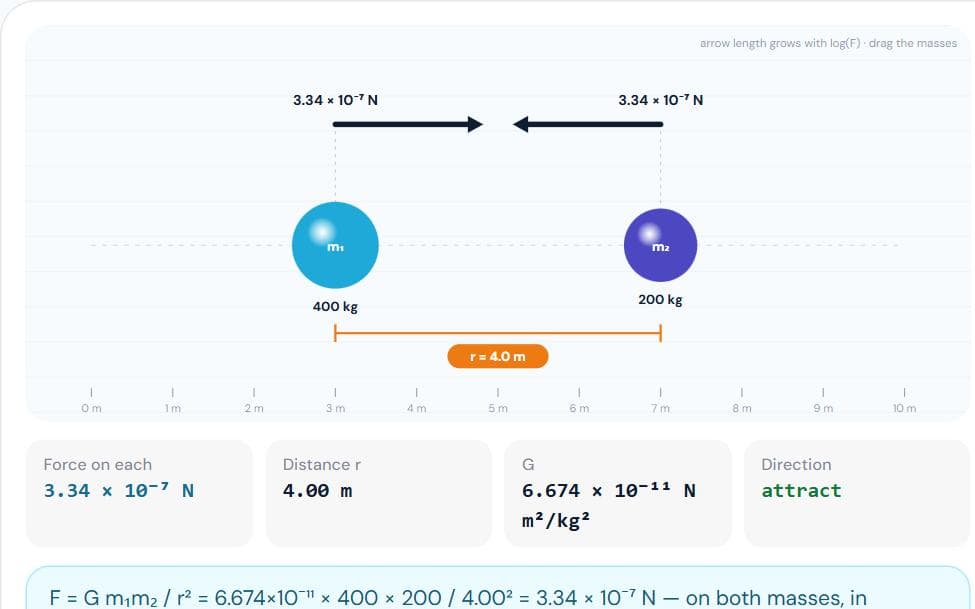
Two masses pull on each other. Change the masses and the distance and watch F = Gm₁m₂/r² — and see that both feel exactly the same force.

Interactive virtual lab · no download · works on phones and laptops

Chapter
Gravitation
For
Class 9 · Class 11 · NEET
Time
~8 min

Gravity Force Lab is a Pro simulation

Pro opens all 125 virtual labs — 483 simulations with guides and quizzes.

How to use it

  1. 1Drag the masses closer or apart.
  2. 2Change each mass with its slider.
  3. 3Read the force on each, in newtons or scientific notation.
  4. 4Turn on the distance ruler.

What to notice

  • Double one mass → double the force. Double the distance → a quarter of the force.
  • The two forces are equal and opposite (Newton's third law).
  • G = 6.674 × 10⁻¹¹ N m²/kg² is tiny, so everyday masses barely attract.

For teachers

A ready-made teaching kit comes with this lab

  • Lesson plan

    18 min, 4 steps

  • Ask the class

    3 questions with answers

  • Quick quiz

    6 questions, printable

  • Key formulas

    2 formulas

About the Gravity Force Lab simulation

Newton's law of gravitation says every two masses attract with a force proportional to the product of their masses and inversely proportional to the square of the distance between them. The force on each mass is the same size, even if one is a planet and the other is an apple.

In this gravity force lab you change the two masses and drag them apart, reading the force in newtons with scientific notation. Double the distance and the force drops to a quarter. It fits Gravitation in Class 9 and Class 11 and the inverse-square questions in NEET.

Also covers: newton's law of gravitation, universal gravitational constant, inverse square law, third law.
Frequently asked questions

What happens to the force if the distance is doubled?

It becomes one-quarter, because F ∝ 1/r².

Is the force on the smaller mass smaller?

No — by Newton's third law both masses feel forces of equal size in opposite directions. The smaller mass simply accelerates more.

Why don't we feel the pull of the people around us?

G is tiny. Two 60 kg people 1 m apart attract with about 2.4 × 10⁻⁷ N.