About the Hooke's Law simulation
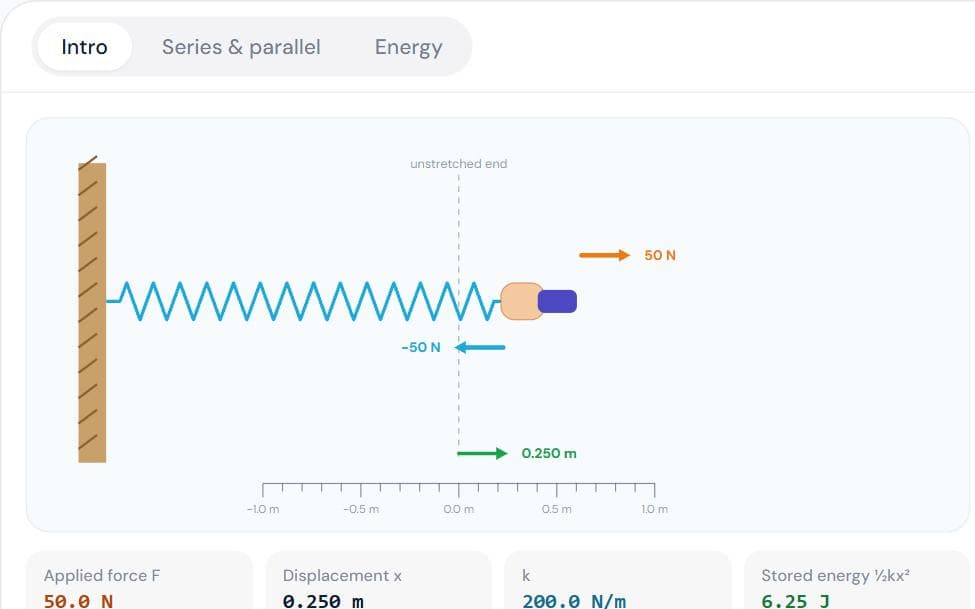
Hooke's law says that the force needed to stretch or compress a spring is proportional to how far you stretch it: F = kx. The constant k, the spring constant, measures stiffness in newtons per metre. The law holds until the spring is stretched past its elastic limit.
This Hooke's law simulation lets you pull a single spring, or two springs joined in series or in parallel, and read the applied force, displacement and stored energy. You can see why two identical springs in parallel are twice as stiff and in series half as stiff. It supports Mechanical Properties of Solids and Oscillations in Class 11 and the spring-combination problems common in JEE.
Also covers: spring constant, restoring force, elastic potential energy, springs in series, springs in parallel.