Skip to content
Modern Physics · Physics

Models of the Hydrogen Atom Simulation

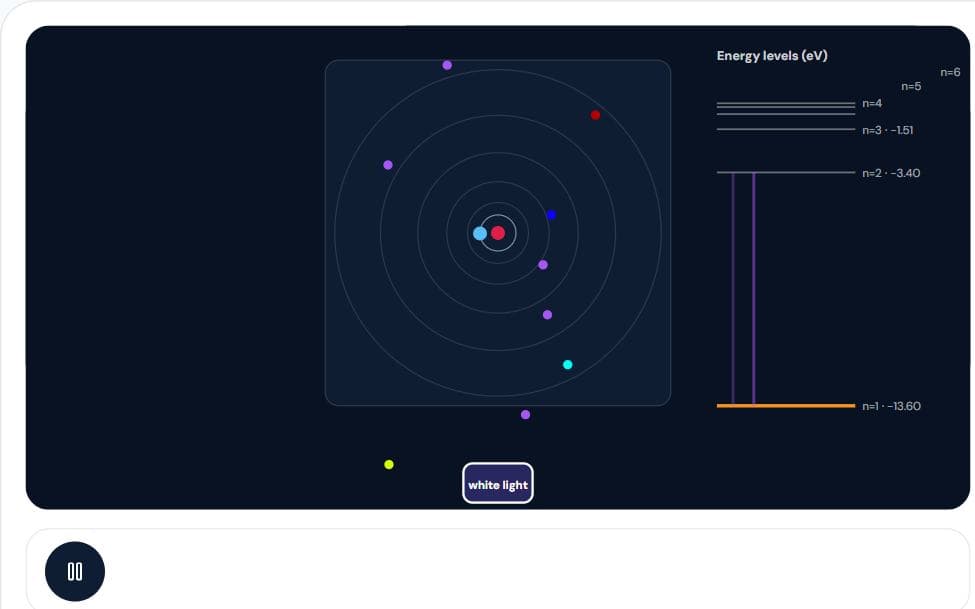
Shine light on a hydrogen atom and compare the classical, plum-pudding and Bohr models. Only the Bohr atom absorbs and emits the exact lines the spectrometer records.

Interactive virtual lab · no download · works on phones and laptops

Chapter
Atoms
For
Class 12 · JEE · NEET
Time
~15 min

Models of the Hydrogen Atom is a Pro simulation

Pro opens all 125 virtual labs — 483 simulations with guides and quizzes.

How to use it

  1. 1Choose a model, then switch on the light.
  2. 2Use white light, or a single wavelength from the slider.
  3. 3Watch the electron jump and the spectrometer collect emitted photons.
  4. 4Open the energy diagram to see each transition.

What to notice

  • Bohr energies are Eₙ = −13.6/n² eV, and orbit radii grow as n².
  • A photon is absorbed only if its energy matches a gap between levels.
  • Drops to n = 1 give the Lyman (UV) series, to n = 2 the visible Balmer series.
  • The classical atom would spiral in and collapse — the model fails.

For teachers

A ready-made teaching kit comes with this lab

  • Lesson plan

    23 min, 4 steps

  • Ask the class

    3 questions with answers

  • Quick quiz

    7 questions, printable

  • Key formulas

    3 formulas

About the Models of the Hydrogen Atom simulation

Models of the hydrogen atom improved as experiments demanded. Thomson's plum pudding and a classical orbiting electron could not explain why hydrogen gives off light at only certain wavelengths. Bohr's model fixed the electron to allowed orbits with energy −13.6/n² eV; jumping between them emits or absorbs a photon of exactly the energy difference.

In this models of the hydrogen atom simulation you shine white light or one wavelength at a billiard-ball, plum-pudding, classical or Bohr atom, see which photons are absorbed and emitted, and follow the electron on an energy-level diagram. It covers Atoms in Class 12, JEE and NEET.

Also covers: bohr model, plum pudding, spectral lines, balmer, lyman, energy levels, rydberg.
Frequently asked questions

What is the ionisation energy of hydrogen?

13.6 eV — the energy to take the electron from n = 1 to infinity.

Which series is in visible light?

The Balmer series: transitions down to n = 2.

Why did the classical model fail?

An orbiting charge should radiate continuously and spiral into the nucleus, and it can't explain sharp spectral lines.