Skip to content
Mechanics · Physics

Inclined Plane with Friction Simulation

Put a block on a slope and see every force on it: weight and its components, the normal force, friction and a push. Tilt it until it slips to find the angle of repose, then compare static and kinetic friction.

Interactive virtual lab · no download · works on phones and laptops

Chapter
Laws of Motion (NLM)
For
Class 9 · Class 11 · JEE · NEET
Time
~12 min

Inclined Plane with Friction is a Pro simulation

Pro opens all 125 virtual labs — 483 simulations with guides and quizzes.

How to use it

  1. 1Set the angle, mass and friction.
  2. 2Press Release, or push it with F.
  3. 3Find the angle of repose: the slope tilts until the block slips.

What to notice

  • N = mg cos θ, not mg.
  • Static friction is only as large as it needs to be, up to μₛN.
  • The block slips when tan θ = μₛ, whatever its mass.
  • Sliding down, a = g(sin θ − μₖ cos θ); on a smooth slope a = g sin θ.

For teachers

A ready-made teaching kit comes with this lab

  • Lesson plan

    19 min, 4 steps

  • Ask the class

    3 questions with answers

  • Quick quiz

    5 questions, printable

  • Key formulas

    3 formulas

About the Inclined Plane with Friction simulation

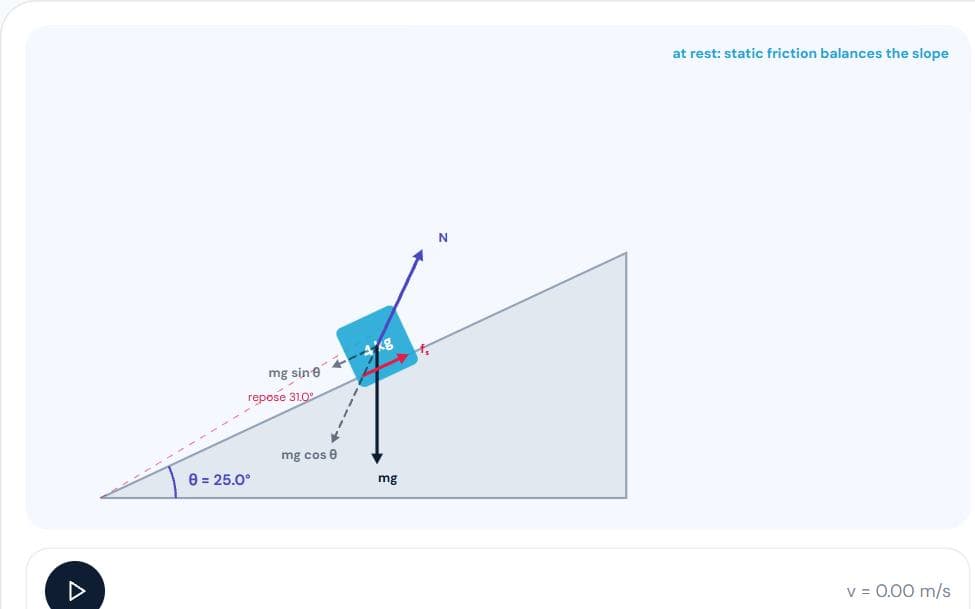
On a slope of angle θ, a block's weight mg splits into mg sin θ down the slope and mg cos θ into it. The slope pushes back with N = mg cos θ, so the normal force is less than the weight. Friction acts along the slope: static friction matches whatever is needed to keep the block still, up to μₛN, and once it slides, kinetic friction μₖN opposes the motion.

This inclined plane simulation draws every force on the block from those rules — weight and its components, normal force, friction and an optional push along the slope — and lets the block move when they do not balance. Tilt the slope slowly and the block slips at the angle of repose, tan θ = μₛ, whatever its mass. The readouts show the friction actually acting next to its limit, so you can see static friction adjust itself.

Also covers: block on incline, inclined plane, mg sin theta, mg cos theta, angle of repose, static friction, kinetic friction, free body diagram, normal force on incline, limiting friction.
Frequently asked questions

Why is the normal force on an incline mg cos θ?

The slope only pushes at right angles to its surface, and it only has to balance the part of the weight pressing into it, which is mg cos θ.

What is the angle of repose?

The steepest angle at which a body rests on a surface without sliding. At that angle mg sin θ = μₛ mg cos θ, so tan θ = μₛ.

What force is needed to push a block up an incline at constant speed?

F = mg sin θ + μₖ mg cos θ: enough to balance the weight's component down the slope and the kinetic friction, which also acts down the slope when the block moves up.