Skip to content
Magnetism · Physics

Induced Magnetism Simulation: a Chain of Nails

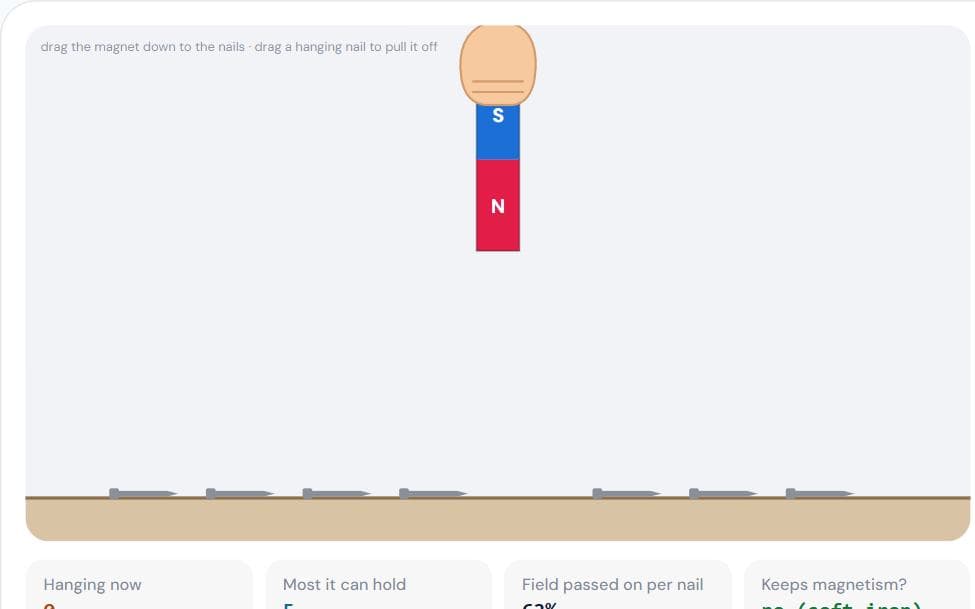
Pick up iron nails with a magnet and hang a chain from it: each nail becomes a magnet and holds the next. Pull the top nail off and the soft-iron chain falls apart; steel pins stay stuck together.

Interactive virtual lab · no download · works on phones and laptops

Chapter
Magnetism and Matter
For
Class 6–10 · 12
Time
~8 min

Induced Magnetism: a Chain of Nails is a Pro simulation

Pro opens all 125 virtual labs — 483 simulations with guides and quizzes.

How to use it

  1. 1Drag the magnet down to the nails on the table to pick them up.
  2. 2Drag a nail in the chain away to pull it off.
  3. 3Change the material and the magnet's strength in the panel.
  4. 4Flip the magnet to see the induced poles swap.

What to notice

  • A magnet turns nearby iron into a magnet — the nail's end next to the magnet's N becomes an S.
  • Each nail passes on a weaker field, so a chain can only be so long; a stronger magnet holds more.
  • Soft iron loses its magnetism the moment the magnet is gone; steel keeps some (high retentivity).
  • Aluminium and copper are not attracted at all: they are not ferromagnetic.

For teachers

A ready-made teaching kit comes with this lab

  • Lesson plan

    18 min, 4 steps

  • Ask the class

    3 questions with answers

  • Quick quiz

    6 questions, printable

  • Key formulas

    0 formulas

About the Induced Magnetism: a Chain of Nails simulation

A magnet can turn a nearby piece of iron into a magnet — magnetic induction. The end of an iron nail touching a magnet's N pole becomes an S pole, so the two attract, and the nail's other end becomes an N pole that can hold another nail. Each nail passes on a weaker field, so a chain can only be so long.

In this induced magnetism simulation you pick up soft-iron nails or steel pins with a magnet, hang them in a chain, change the magnet's strength, and pull a nail off the chain: soft iron lets go of the nails below at once, while steel keeps its magnetism and they stay stuck. Aluminium and copper aren't picked up at all. It suits magnetism in Classes 6–10 and Magnetism and Matter in Class 12.

Also covers: magnetic induction, induced magnetism, temporary magnet, soft iron, steel, retentivity, ferromagnetic, magnetic materials, chain of nails.
Frequently asked questions

Why does a magnet attract an unmagnetised iron nail?

It magnetises the nail with the opposite pole facing it, and opposite poles attract.

Why are permanent magnets made of steel and electromagnets of soft iron?

Steel keeps its magnetism (high retentivity); soft iron loses it as soon as the field is removed, which an electromagnet needs.

Why can't a magnet pick up aluminium?

Aluminium isn't ferromagnetic, so the magnet can't magnetise it strongly enough to attract it.