Skip to content
Magnetism · Physics

Electromagnetic Induction: Flux & EMF Graphs Simulation

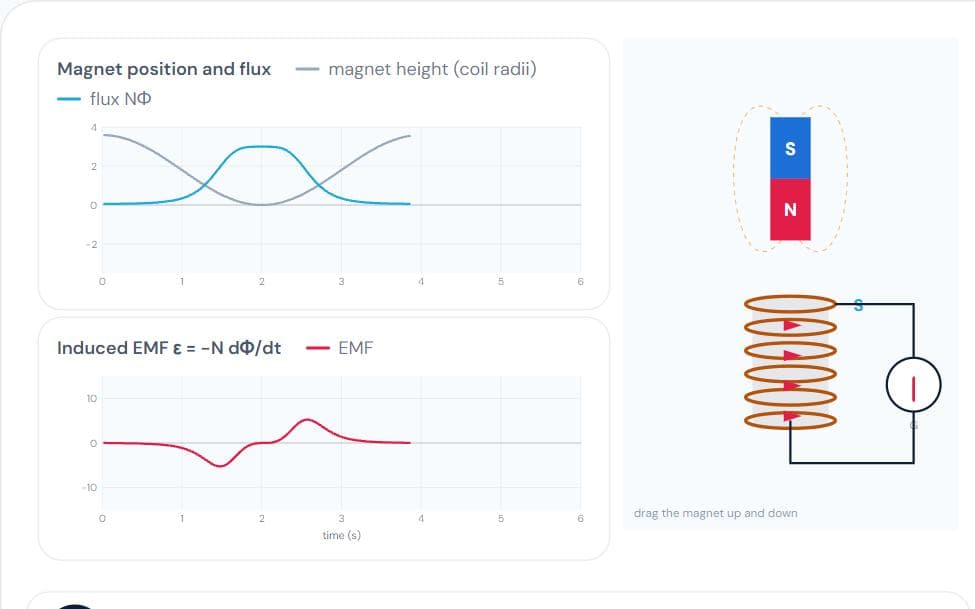
Move a magnet in and out of a coil and see the magnetic flux and the induced current plotted against time. The current follows how fast the flux changes, reverses as the magnet leaves, and always flows to oppose the change — Lenz's law.

Interactive virtual lab · no download · works on phones and laptops

Chapter
Electromagnetic Induction
For
Class 10 · Class 12 · JEE · NEET
Time
~10 min

Electromagnetic Induction: Flux & EMF Graphs is a Pro simulation

Pro opens all 125 virtual labs — 483 simulations with guides and quizzes.

How to use it

  1. 1Drag the magnet up and down, or pick a ready-made motion.
  2. 2Watch the flux and EMF graphs draw themselves.
  3. 3Flip the magnet or change the winding direction and compare.
  4. 4Change the number of turns to scale the EMF.

What to notice

  • The induced EMF is the rate of change of flux: ε = −N dΦ/dt. Faster motion, bigger EMF.
  • A magnet at rest induces nothing, wherever it is.
  • The current reverses between moving in and moving out, and when the magnet is flipped.
  • The coil's induced pole always opposes the magnet's motion (Lenz's law).

For teachers

A ready-made teaching kit comes with this lab

  • Lesson plan

    19 min, 4 steps

  • Ask the class

    4 questions with answers

  • Quick quiz

    6 questions, printable

  • Key formulas

    2 formulas

About the Electromagnetic Induction: Flux & EMF Graphs simulation

Faraday's law says the EMF induced in a coil equals the rate of change of magnetic flux through it, times the number of turns. A graph makes that concrete: the induced EMF is the slope of the flux–time graph, turned upside down. A magnet sitting still inside a coil — however much flux — induces nothing; a magnet moving fast induces a lot.

In this electromagnetic induction graphs simulation you move a bar magnet in and out of a coil (or let it fall through) and watch magnet position, flux and induced EMF plotted against time, with a galvanometer and arrows showing the current. Flip the magnet, reverse the winding and change the number of turns. Lenz's law is shown by the pole the coil develops to oppose the motion. It covers Electromagnetic Induction in Class 12 and Magnetic Effects of Current in Class 10, JEE and NEET.

Also covers: Faraday's law, Lenz's law, induced current, induced emf graph, magnetic flux, magnet through a coil, galvanometer, electromagnetic induction.
Frequently asked questions

Why is there no current when the magnet stops inside the coil?

The flux is no longer changing. Faraday's law depends on dΦ/dt, not on Φ itself.

How do you read the EMF from a flux–time graph?

The EMF is minus the slope: where the flux rises fastest the EMF is largest (and negative), and at a peak of flux the EMF is zero.

What does Lenz's law say for a magnet approaching a coil?

The induced current makes the near end of the coil the same pole as the approaching one, so it repels the magnet and opposes the change.

What happens to the EMF if the magnet moves twice as fast?

The flux changes twice as fast, so the EMF roughly doubles.