Skip to content
Mechanics · Physics

Kepler's Laws Simulation

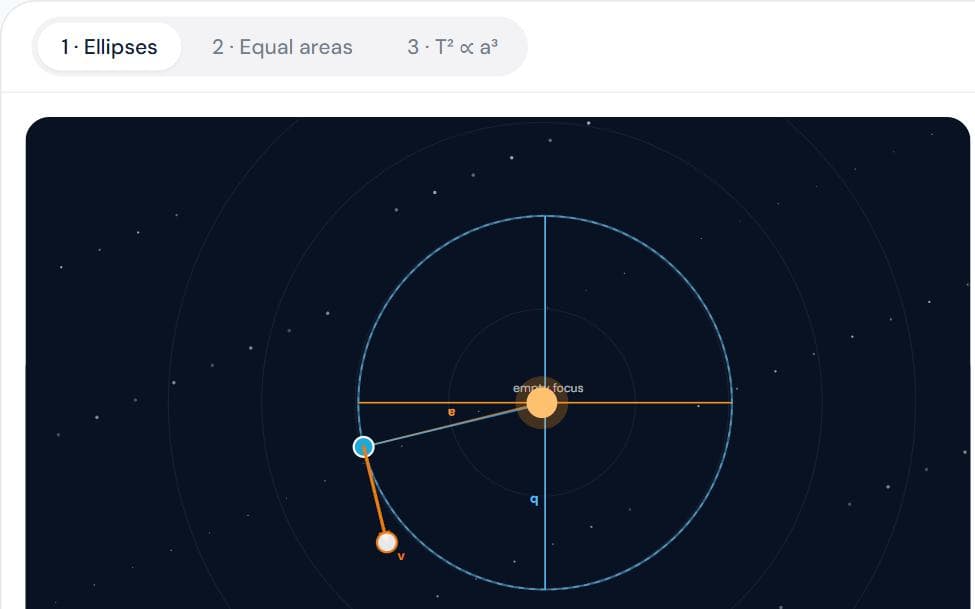
Drag a planet's velocity and watch its orbit become an ellipse with the sun at one focus. Sweep equal areas in equal times, and check T² ∝ a³.

Interactive virtual lab · no download · works on phones and laptops

Chapter
Gravitation
For
Class 11 · JEE · NEET
Time
~15 min

Kepler's Laws is a Pro simulation

Pro opens all 125 virtual labs — 483 simulations with guides and quizzes.

How to use it

  1. 1Drag the arrow on the planet to change its velocity.
  2. 2First law: show the foci, axes and eccentricity.
  3. 3Second law: switch on area sweeps and compare their sizes.
  4. 4Third law: plot T against a, T² against a³.

What to notice

  • Orbits are ellipses with the sun at one focus (first law).
  • Equal areas in equal times: the planet is fastest at perihelion (second law).
  • T² / a³ is the same for every orbit around the same star (third law).
  • A circle is the ellipse with zero eccentricity.

For teachers

A ready-made teaching kit comes with this lab

  • Lesson plan

    22 min, 4 steps

  • Ask the class

    3 questions with answers

  • Quick quiz

    6 questions, printable

  • Key formulas

    2 formulas

About the Kepler's Laws simulation

Kepler's three laws describe how planets move: orbits are ellipses with the Sun at one focus; a line from the Sun to the planet sweeps out equal areas in equal times; and the square of the orbital period is proportional to the cube of the orbit's size. Newton later showed all three follow from his law of gravitation.

In this Kepler's laws simulation you shape an orbit, mark equal-time slices to see the equal areas, and plot T² against a³ for several orbits. You can see the planet speed up near the Sun (perihelion) and slow down far away. It covers Gravitation in Class 11, JEE and NEET.

Also covers: ellipse, equal areas, orbital period, semi-major axis, eccentricity, planets.

Frequently asked questions

Why does a planet move faster when it is closer to the Sun?

Angular momentum is conserved (Kepler's second law), so a shorter radius must be made up by a higher speed.

If one orbit is 4 times larger than another, how much longer is its period?

T ∝ a^(3/2), so the period is 4^(3/2) = 8 times longer.

Where is the Sun in an elliptical orbit?

At one focus of the ellipse, not at its centre.