Skip to content
Electricity · Physics

Kirchhoff's Loop Rule: Signs Around the Loop Simulation

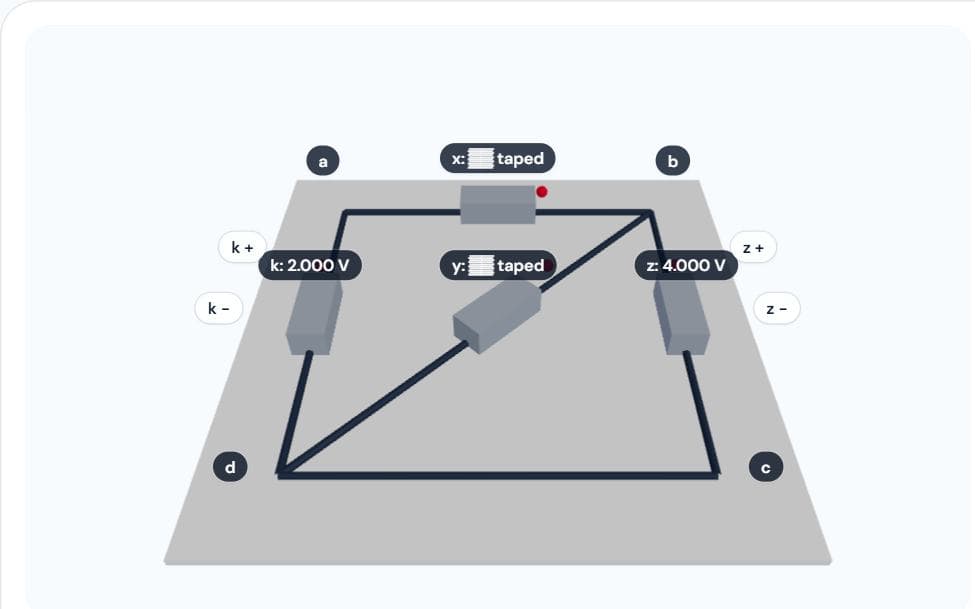
Four sealed components on a square and its diagonal, two meters taped over. A test charge walks three loops while a fence rises and falls with the potential; each closed loop gives one equation and reveals one hidden meter. Change the known voltages directly on the 3D circuit.

Interactive virtual lab · no download · works on phones and laptops

Chapter
Current Electricity
For
Class 12 · JEE
Time
~12 min

Kirchhoff's Loop Rule: Signs Around the Loop is a Pro simulation

Pro opens all 125 virtual labs — 483 simulations with guides and quizzes.

How to use it

  1. 1Press play and watch the walk.
  2. 2Tap k ± and z ± on the circuit or use the sliders.
  3. 3Switch the walking direction.

What to notice

  • The potential returns to its start round any loop: ΣV = 0.
  • With the push +V, against it −V, a wire 0.
  • Reversing the walk flips every sign but not the answers.

For teachers

A ready-made teaching kit comes with this lab

  • Lesson plan

    19 min, 4 steps

  • Ask the class

    3 questions with answers

  • Quick quiz

    5 questions, printable

  • Key formulas

    1 formulas

About the Kirchhoff's Loop Rule: Signs Around the Loop simulation

Kirchhoff's loop rule says that the potential differences around any closed loop add up to zero. This simulation teaches it with voltages alone. Four sealed components sit on a square and its diagonal; only two meters can be read, the other two are covered with tape. A test charge walks three loops while a fence rises and falls with the potential along its path, always closing at the height it started.

Each closed loop gives one equation and peels the tape off one meter: the right triangle gives V_y = V_z, the left triangle V_x = V_z − V_k, and the outer square checks both. Treat each component like a battery: walking with its push counts +V, against it −V, a plain wire nothing. Reverse the walking direction and every sign flips while the answers stay. As Pathik Sir suggested, you can change the known voltages directly on the 3D circuit.

Also covers: kirchhoff's voltage law, kirchhoff's loop rule, sign convention, potential around a loop, sum of voltages zero.
Frequently asked questions

What is Kirchhoff's voltage law?

The algebraic sum of the potential differences around any closed loop in a circuit is zero — energy conservation for a charge that returns to its starting point.

How do I choose signs in Kirchhoff's loop rule?

Pick a walking direction. Crossing a source from − to + is a rise (+V), from + to − a drop (−V). Be consistent; the other direction just flips every sign.

Which loop should I start with?

One with only one unknown, so its equation gives the answer directly.