Skip to content
Mechanics · Physics

Masses & Springs Simulation

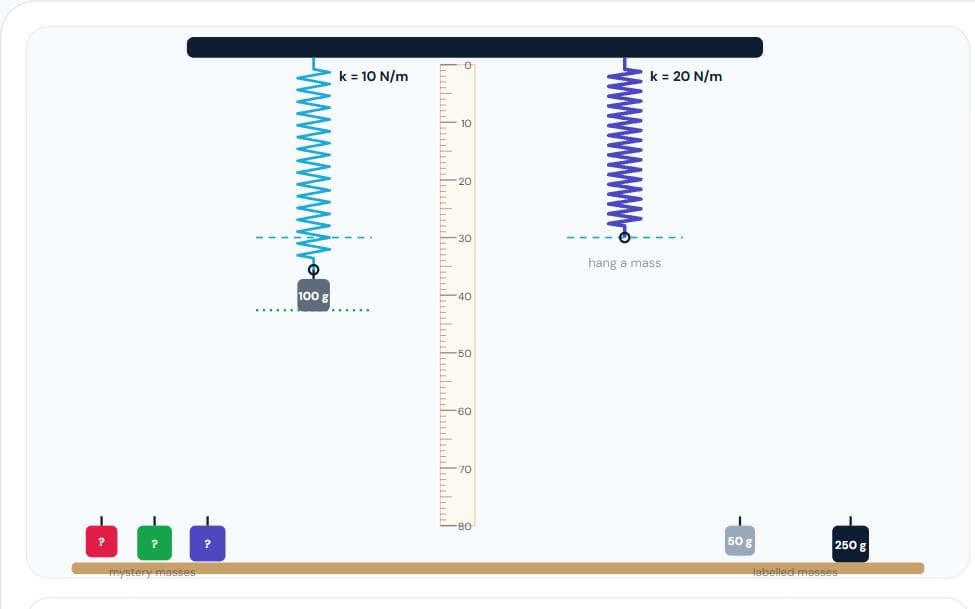
Hang masses on springs and let them bounce. Change k, damping and gravity, compare two springs side by side, and time the period T = 2π√(m/k).

Interactive virtual lab · no download · works on phones and laptops

Chapter
Oscillations
For
Class 11 · JEE · NEET
Time
~15 min

Masses & Springs is a Pro simulation

Pro opens all 125 virtual labs — 483 simulations with guides and quizzes.

How to use it

  1. 1Drag a mass onto a spring hook.
  2. 2Pull the mass down and let go.
  3. 3Change spring constant, damping and planet.
  4. 4Use the stopwatch and the energy bars.

What to notice

  • The period depends on m and k, not on the amplitude or on g.
  • At equilibrium the spring stretches mg/k.
  • Velocity is largest at equilibrium; acceleration is largest at the ends.
  • Damping turns the oscillation's energy into heat.

For teachers

A ready-made teaching kit comes with this lab

  • Lesson plan

    22 min, 4 steps

  • Ask the class

    3 questions with answers

  • Quick quiz

    6 questions, printable

  • Key formulas

    4 formulas

About the Masses & Springs simulation

Hang a mass on a spring and pull it down: it bobs up and down in simple harmonic motion. The stiffer the spring or the lighter the mass, the faster it oscillates. Unlike a pendulum, the period of a spring does not depend on g — gravity only shifts where the mass sits at rest.

In this mass–spring simulation you hang different masses, change the spring constant, add damping and watch the kinetic, gravitational and elastic energy bars trade places as it oscillates. Measure how far the spring stretches to find k, then time the oscillations to check T = 2π√(m/k). It is built for the Oscillations chapter of Class 11 and for JEE and NEET problems on springs.

Also covers: simple harmonic motion, shm, spring mass system, time period, damping, planet x.

Frequently asked questions

Does gravity change the period of a mass on a spring?

No. Gravity moves the equilibrium position down by mg/k, but the oscillation about that point still has T = 2π√(m/k). The same spring would oscillate at the same rate on the Moon.

What happens to the period if the mass is quadrupled?

It doubles, since T is proportional to √m.

What does damping do?

Friction or air resistance takes energy out each cycle, so the amplitude shrinks over time. Light damping barely changes the period.