Skip to content
Mechanics · Physics

Meeting & Overtaking Simulation

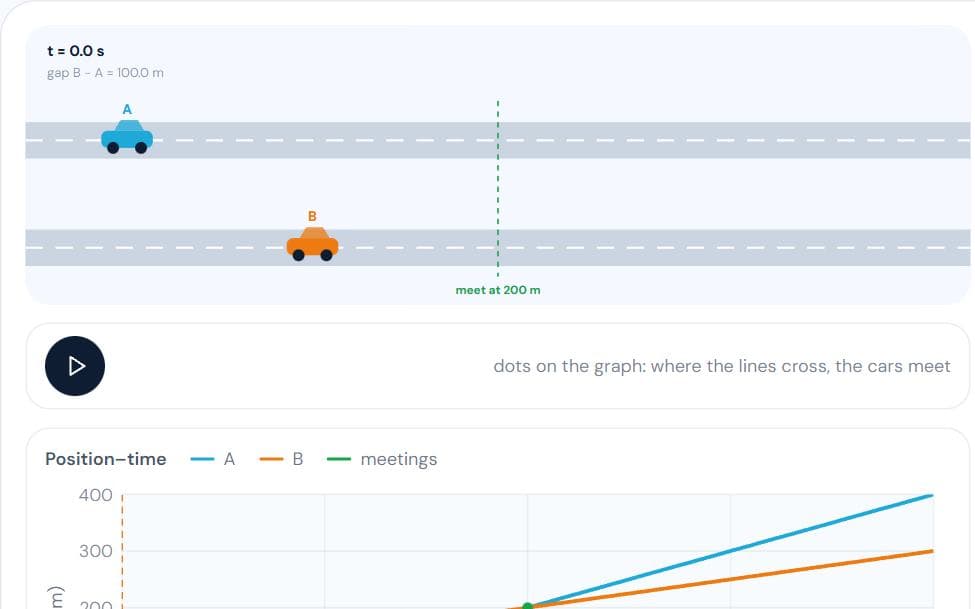
Set two cars going with their own start, speed, acceleration and delay, and find when and where they meet. The meetings are where the x–t graphs cross; switch to car A's view to see it as relative motion.

Interactive virtual lab · no download · works on phones and laptops

Chapter
Kinematics
For
Class 11 · JEE
Time
~10 min

Meeting & Overtaking is a Pro simulation

Pro opens all 125 virtual labs — 483 simulations with guides and quizzes.

How to use it

  1. 1Pick a situation, or set each car's sliders.
  2. 2Press play; green lines mark the meeting points.
  3. 3Turn on the view from car A.

What to notice

  • They meet where their position–time graphs cross.
  • Chasing at constant speeds, the gap closes at the difference of the speeds; head-on, at the sum.
  • From A's frame, B moves with vB − vA and aB − aA.
  • A braking car can be overtaken twice: two crossings.

For teachers

A ready-made teaching kit comes with this lab

  • Lesson plan

    18 min, 4 steps

  • Ask the class

    3 questions with answers

  • Quick quiz

    5 questions, printable

  • Key formulas

    3 formulas

About the Meeting & Overtaking simulation

Two bodies on the same straight road meet when they are at the same position at the same time. Write x(t) for each and set them equal: with constant accelerations this is at most a quadratic, so there can be no meeting, one, or two. On an x–t graph the meetings are where the two lines cross.

This meeting and overtaking simulation lets you set each car's start position, velocity, acceleration and start delay, then finds every meeting exactly and marks it on the road and the graph. Switch to the view from car A to see the same problem as relative motion: B moves with the relative velocity vB − vA, and they meet when the relative displacement returns to zero.

Also covers: two cars meet, when and where do they meet, overtaking problem, relative velocity in one dimension, catch up problem, head on, position time graph intersection.

Frequently asked questions

How do you solve a two-car meeting problem?

Write the position of each car as a function of time from the same origin, set them equal and solve for t. Put t back into either equation to find where they meet.

Why can two cars meet twice?

If one accelerates or brakes, x(t) is a parabola, and a parabola can cross the other car's line twice — first one overtakes, then the other passes it back.

How does relative velocity make the problem easier?

In one car's frame that car is at rest, so you only follow the other one: it starts at the initial gap and moves with the relative velocity and acceleration.