Skip to content
Light & Optics · Physics

Molecules & Light Simulation

Shine microwaves, infrared, visible or ultraviolet light on CO₂, H₂O, O₂, O₃ and more. See which photons are absorbed and what the molecule does — rotate, vibrate, glow or break apart.

Interactive virtual lab · no download · works on phones and laptops

Chapter
Dual Nature · Environment
For
Class 11 · Class 12
Time
~8 min

Molecules & Light is a Pro simulation

Pro opens all 125 virtual labs — 483 simulations with guides and quizzes.

How to use it

  1. 1Pick a light source and a molecule.
  2. 2Turn on the emitter and adjust the photon rate.
  3. 3Watch the molecule and the spectrum bar.

What to notice

  • A molecule absorbs only photons whose energy matches one of its transitions.
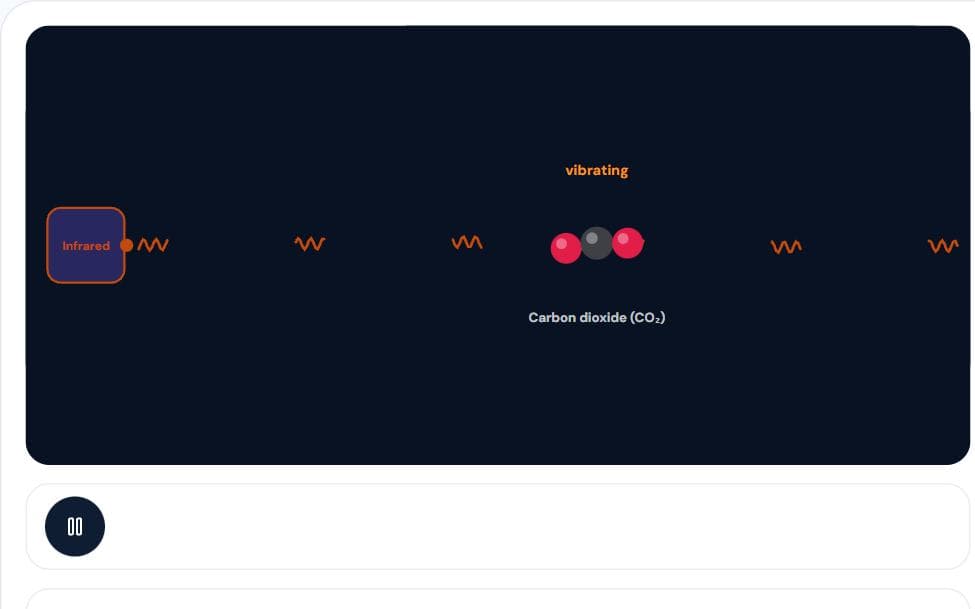
  • Microwaves make polar molecules rotate; infrared makes bonds vibrate.
  • CO₂ and H₂O absorb infrared — that is the greenhouse effect.
  • UV photons carry enough energy to break bonds.

For teachers

A ready-made teaching kit comes with this lab

  • Lesson plan

    18 min, 4 steps

  • Ask the class

    3 questions with answers

  • Quick quiz

    6 questions, printable

  • Key formulas

    1 formulas

About the Molecules & Light simulation

Whether a molecule absorbs light depends on the energy of the photon. Microwaves make some molecules rotate, infrared makes them vibrate, visible light can lift electrons to higher levels, and ultraviolet can break bonds altogether. That is why carbon dioxide and water vapour trap infrared (the greenhouse effect) and why ozone blocks ultraviolet.

In this molecules and light simulation you fire microwave, infrared, visible or ultraviolet photons at CO, N₂, O₂, H₂O, CO₂, NO₂ and O₃ and see them rotate, vibrate, glow or break apart. It connects Dual Nature of Radiation in Class 12 and the photon energy E = hf with environmental chemistry.

Also covers: greenhouse effect, infrared absorption, uv, microwave, photon energy, molecular vibration, ozone.
Frequently asked questions

Why does CO₂ absorb infrared but not visible light?

Infrared photons match the energy of its bond vibrations; visible photons don't match any transition in CO₂.

Why doesn't nitrogen absorb infrared?

N₂ is symmetric, so its vibration doesn't change its charge distribution, and it can't absorb infrared that way.

What does ultraviolet light do to ozone?

Its photons carry enough energy to split O₃ into O₂ and O — which is how the ozone layer absorbs UV.