Skip to content
Mechanics · Physics

Monkey and the Hunter Simulation

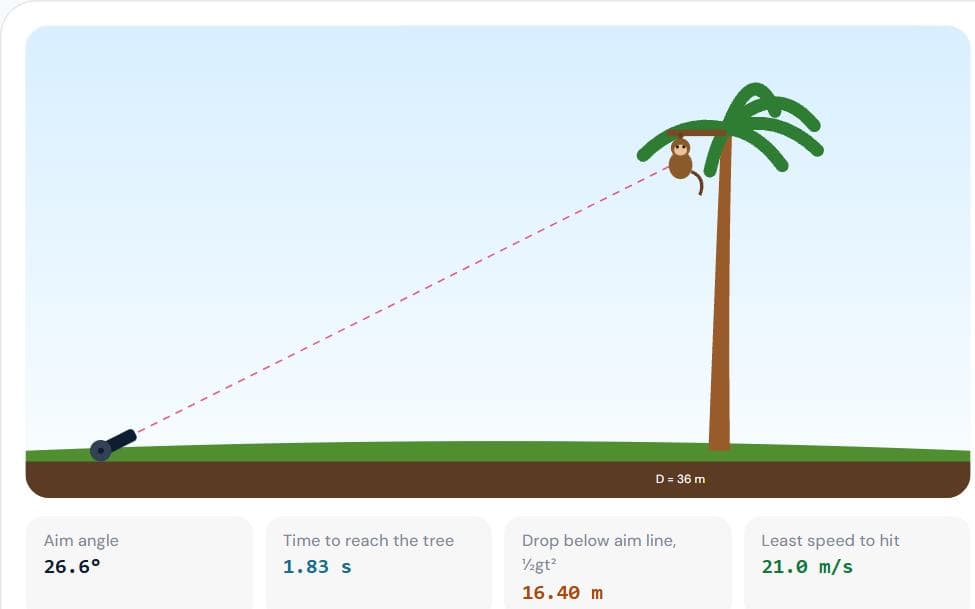
Aim a dart straight at a monkey that lets go of the branch the moment you fire, and it still hits. See why both fall the same distance below the aim line.

Interactive virtual lab · no download · works on phones and laptops

Chapter
Motion in a Plane
For
Class 11 · JEE · NEET
Time
~8 min

Monkey and the Hunter is a Pro simulation

Pro opens all 125 virtual labs — 483 simulations with guides and quizzes.

How to use it

  1. 1Set the dart speed, the distance and the height.
  2. 2Fire, then try aiming above the monkey.
  3. 3Untick 'Lets go' to see the dart pass below.
  4. 4Try the Moon and zero gravity.

What to notice

  • Dart and monkey both fall ½gt², so aiming straight at the monkey always hits.
  • It works for any speed fast enough to arrive before the monkey lands.
  • If the monkey holds on, the same aim misses low by ½gt².
  • With no gravity it still hits — the aim line is straight.

For teachers

A ready-made teaching kit comes with this lab

  • Lesson plan

    17 min, 4 steps

  • Ask the class

    3 questions with answers

  • Quick quiz

    5 questions, printable

  • Key formulas

    3 formulas

About the Monkey and the Hunter simulation

A hunter aims a dart straight at a monkey hanging from a branch. The monkey lets go at the instant the dart is fired, hoping to dodge it. It cannot: gravity pulls the dart below its straight aim line by ½gt², and pulls the monkey down by exactly the same ½gt², so they meet. Aiming directly at the target is right, whatever the dart's speed.

This monkey and hunter simulation lets you change the speed, the distance and the height, aim above or below the monkey, keep the monkey holding on, and try the Moon or no gravity at all. It shows the drop below the aim line and the least speed that reaches the tree before the monkey hits the ground.

Also covers: monkey hunter problem, projectile hits falling target, aim directly, relative motion under gravity.
Frequently asked questions

Why does the dart hit the falling monkey?

Both fall with the same acceleration g. Measured from the straight aim line, the dart drops ½gt²; the monkey drops ½gt² from where it was. So the dart arrives where the monkey is.

Does the speed of the dart matter in the monkey and hunter problem?

Only in that it must reach the tree before the monkey (or the dart) hits the ground: u ≥ √(g(D² + H²)/2H).

What if the monkey does not let go?

Then the dart passes below it by ½gt²: to hit a stationary target you must aim above it.