Skip to content
Mechanics · Physics

Newton's Cannon and Satellites Simulation

Fire a cannonball from a mountain fast enough to orbit the Earth, or escape it, then launch a satellite at any angle. Watch it sweep equal areas in equal times.

Interactive virtual lab · no download · works on phones and laptops

Chapter
Gravitation
For
Class 11 · JEE · NEET
Time
~12 min

Newton's Cannon and Satellites is a Pro simulation

Pro opens all 125 virtual labs — 483 simulations with guides and quizzes.

How to use it

  1. 1Cannon: set the mountain height and launch speed, then Fire.
  2. 2Use the circular and escape speed buttons.
  3. 3Satellite: set distance, speed and launch angle, then Launch.
  4. 4Turn on the equal-time areas.

What to notice

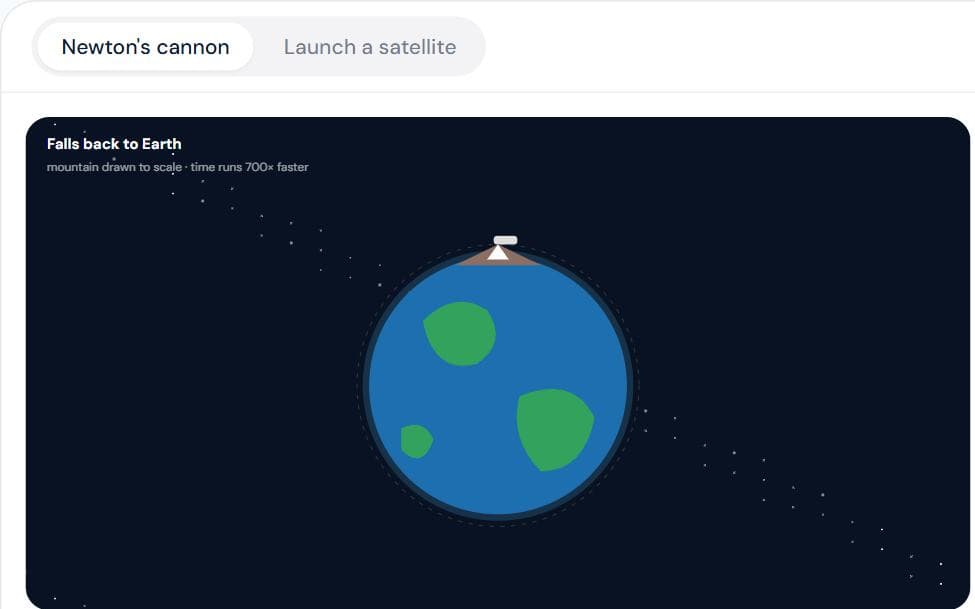
  • Below √(GM/r) the ball falls back; at it, a circular orbit (7.9 km/s at the surface).
  • At √(2GM/r) it escapes (11.2 km/s at the surface).
  • In between, the path is an ellipse.
  • Gravity exerts no torque about the Earth's centre, so equal areas are swept in equal times.

For teachers

A ready-made teaching kit comes with this lab

  • Lesson plan

    19 min, 4 steps

  • Ask the class

    3 questions with answers

  • Quick quiz

    5 questions, printable

  • Key formulas

    4 formulas

About the Newton's Cannon and Satellites simulation

In the Principia Newton imagined a cannon on a very high mountain. Fire the ball slowly and it falls back to Earth; fire it faster and it lands further round the curved planet; fire it at the right speed and the ground curves away beneath it as fast as it falls — it is in orbit. Faster still, it escapes. The Moon and every satellite are cannonballs that keep missing.

This orbital velocity simulation uses real Earth numbers: 7.9 km/s for a circular orbit at the surface and 11.2 km/s to escape. A second tab launches a satellite at any speed and angle and shades the areas it sweeps in equal times, showing Kepler's second law and the constant angular momentum behind it.

Also covers: orbital velocity, escape velocity, newton cannonball, satellite launch, kepler second law, equal areas.
Frequently asked questions

What is the orbital velocity near the Earth's surface?

About 7.9 km/s: √(GM/R) with GM = 3.99 × 10¹⁴ m³/s² and R = 6371 km.

What is the relation between escape velocity and orbital velocity?

At the same distance, escape velocity is √2 times the circular orbital velocity: 11.2 km/s against 7.9 km/s at the surface.

Why does a satellite sweep equal areas in equal times?

Gravity points at the Earth's centre, so it exerts no torque: angular momentum is conserved, and the areal velocity L/2m with it.