Skip to content
Electricity · Physics

Ohm's Law & Resistance Simulation

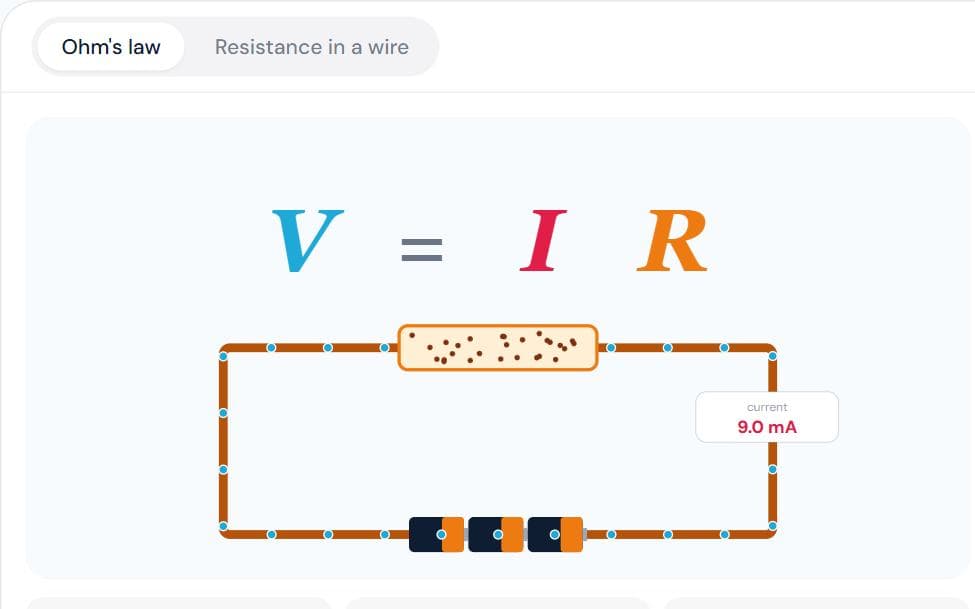
Change voltage and resistance and watch the current — and the letters of V = IR — grow and shrink. Then stretch and thicken a wire to see R = ρL/A.

Interactive virtual lab · no download · works on phones and laptops

Chapter
Current Electricity
For
Class 10 · Class 12 · NEET
Time
~8 min

Ohm's Law & Resistance is a Pro simulation

Pro opens all 125 virtual labs — 483 simulations with guides and quizzes.

How to use it

  1. 1Ohm's law: drag the voltage and resistance sliders.
  2. 2Resistance in a wire: change ρ, length and area.
  3. 3Watch the equation letters resize to match.

What to notice

  • At fixed R, current is proportional to voltage.
  • At fixed V, doubling R halves the current.
  • A longer wire has more resistance; a thicker one has less.
  • Resistivity ρ is a property of the material, not of the wire's shape.

For teachers

A ready-made teaching kit comes with this lab

  • Lesson plan

    18 min, 4 steps

  • Ask the class

    3 questions with answers

  • Quick quiz

    6 questions, printable

  • Key formulas

    3 formulas

About the Ohm's Law & Resistance simulation

Ohm's law says the current through a conductor is proportional to the voltage across it, as long as its temperature stays the same: V = IR. The resistance R itself depends on the wire — longer wires resist more, thicker wires less, and some materials far more than others. That property of the material is its resistivity ρ.

In this Ohm's law simulation the letters of V = IR and R = ρL/A grow and shrink as you change the voltage, resistance, length, area and resistivity, so you can see which way each quantity pulls. It covers Electricity in Class 10 and Current Electricity in Class 12 and NEET.

Also covers: v = ir, resistance in a wire, resistivity, current, voltage, r = rho l / a.
Frequently asked questions

A wire is stretched to twice its length. What happens to its resistance?

It becomes four times as large: the length doubles and the cross-section halves (same volume), so R = ρL/A grows by 2 × 2.

Does resistivity depend on the size of the wire?

No. Resistivity is a property of the material (and temperature); length and area change the resistance, not the resistivity.

What is the slope of a V–I graph?

The resistance R, for an ohmic conductor — a straight line through the origin.