Skip to content
Electricity · Physics

Ohm's Law Bench (3D) Simulation

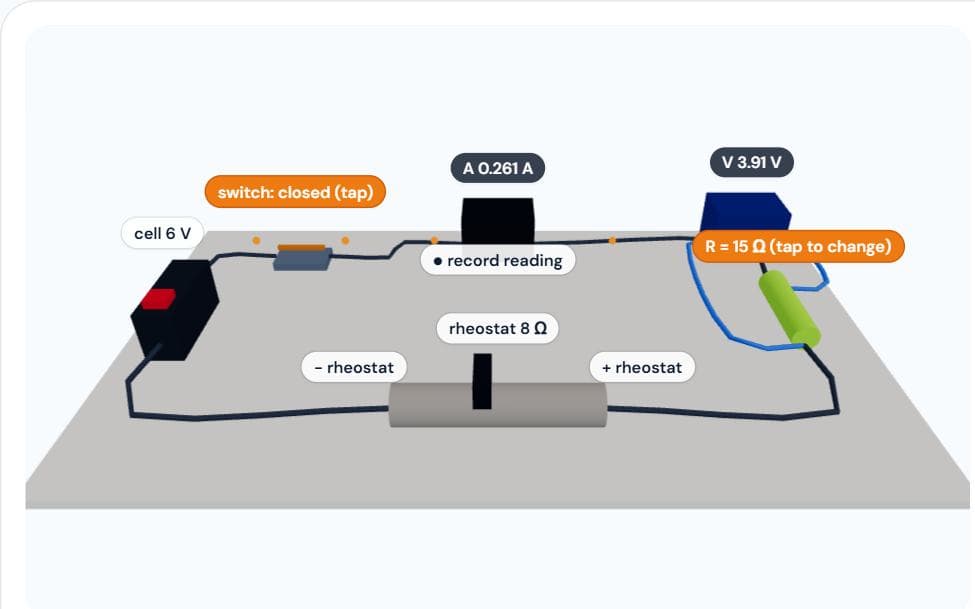
The school Ohm's-law experiment on a 3D bench, worked directly on the circuit: tap the switch, the rheostat's − and +, and the resistor's value. Record readings or run six settings, and read R from the slope of the I–V graph.

Interactive virtual lab · no download · works on phones and laptops

Chapter
Current Electricity
For
Class 10–12 · practical
Time
~15 min

Ohm's Law Bench (3D) is a Pro simulation

Pro opens all 125 virtual labs — 483 simulations with guides and quizzes.

How to use it

  1. 1Tap the chips on the circuit or use the panel.
  2. 2Record readings, or run the six-setting experiment.
  3. 3Read R from the fitted slope.

What to notice

  • The ammeter is in series; the voltmeter is across the resistor only.
  • Every point lies on a line through the origin.
  • V/I equals R at every rheostat setting.

For teachers

A ready-made teaching kit comes with this lab

  • Lesson plan

    21 min, 4 steps

  • Ask the class

    3 questions with answers

  • Quick quiz

    5 questions, printable

  • Key formulas

    2 formulas

About the Ohm's Law Bench (3D) simulation

This simulation is the school Ohm’s-law experiment rebuilt as a 3D bench: a cell, a switch, a rheostat, an ammeter in series and a resistor with a voltmeter across it only. As Pathik Sir suggested, you work it on the circuit itself — tap the switch, the rheostat's − and +, and the resistor's value — rather than through sliders alone.

Record a reading at each rheostat setting, or run the six-setting experiment, and the readings fill a table and an I–V graph. They lie on one straight line through the origin; V/I equals the resistance at every setting, and the fitted slope ΔI/ΔV is 1/R. The meters are ideal and the resistor stays at 25 °C, so its resistance does not change.

Also covers: ohm's law experiment, verification of ohm's law, rheostat, ammeter voltmeter connection, v-i graph, resistance from slope.
Frequently asked questions

Why is the ammeter connected in series and the voltmeter in parallel?

The ammeter must carry the same current as the resistor; the voltmeter must have the same potential difference across it as the resistor, and it draws (ideally) no current.

What is the use of the rheostat in Ohm's law experiment?

It changes the current in the circuit so you can take several readings of V and I.

How do you find resistance from the I–V graph?

Fit a straight line through the origin: its slope is 1/R, so R is the reciprocal of the slope.