Skip to content
Mechanics · Physics

Gravity & Orbits Simulation

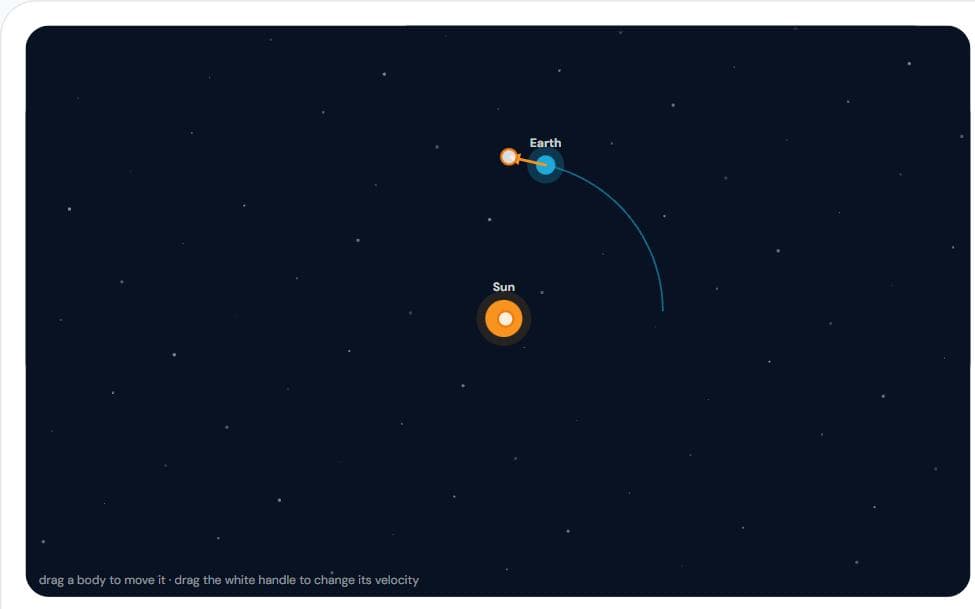
Build a system of up to four bodies and watch them pull on each other. Change masses and velocities, switch gravity off, and see what keeps the Earth and Moon in orbit.

Interactive virtual lab · no download · works on phones and laptops

Chapter
Gravitation
For
Class 9 · Class 11 · JEE
Time
~15 min

Gravity & Orbits is a Pro simulation

Pro opens all 125 virtual labs — 483 simulations with guides and quizzes.

How to use it

  1. 1Pick a preset: Sun–Earth, Sun–Earth–Moon, binary stars, figure-eight.
  2. 2Drag bodies to move them and drag their arrows to change velocity.
  3. 3Change each mass in the panel.
  4. 4Turn gravity off and on.

What to notice

  • Gravity bends a body's path; without it every body moves in a straight line.
  • A circular orbit needs v = √(GM/r).
  • Heavier bodies move less — both bodies orbit their common centre of mass.
  • Momentum of the whole system stays constant.

For teachers

A ready-made teaching kit comes with this lab

  • Lesson plan

    22 min, 4 steps

  • Ask the class

    3 questions with answers

  • Quick quiz

    6 questions, printable

  • Key formulas

    3 formulas

About the Gravity & Orbits simulation

An orbit is a fall that never reaches the ground: a satellite moves sideways fast enough that the ground curves away as quickly as it falls. Gravity provides the centripetal force, so for a circular orbit the speed is fixed by the mass of the central body and the radius.

In this gravity and orbits simulation you start from a Sun and Earth, a Sun–Earth–Moon system, binary stars, a figure-eight or a slingshot, change the masses, switch gravity off to see the straight-line motion it was bending, and trace the paths and the centre of mass. It supports Gravitation in Class 9 and Class 11, including orbital speed and escape velocity in JEE.

Also covers: my solar system, n-body, sun earth moon, satellite, orbital velocity, escape.

Frequently asked questions

Why doesn't the Moon fall onto the Earth?

It is falling, all the time — but its sideways speed carries it past the Earth, so it keeps missing. Gravity just bends its straight-line path into a circle.

Does an orbiting body's path depend on its own mass?

No. In v = √(GM/r) only the central mass appears.

How much faster is escape speed than orbital speed?

√2 times, about 1.41 times, at the same distance.