Skip to content
Mechanics · Physics

Pendulum Lab Simulation

Swing one or two pendulums. Change length, mass, amplitude, gravity and friction, time the period, and find g on Planet X.

Interactive virtual lab · no download · works on phones and laptops

Chapter
Oscillations
For
Class 9 · Class 11 · NEET
Time
~15 min

Pendulum Lab is a Pro simulation

Pro opens all 125 virtual labs — 483 simulations with guides and quizzes.

How to use it

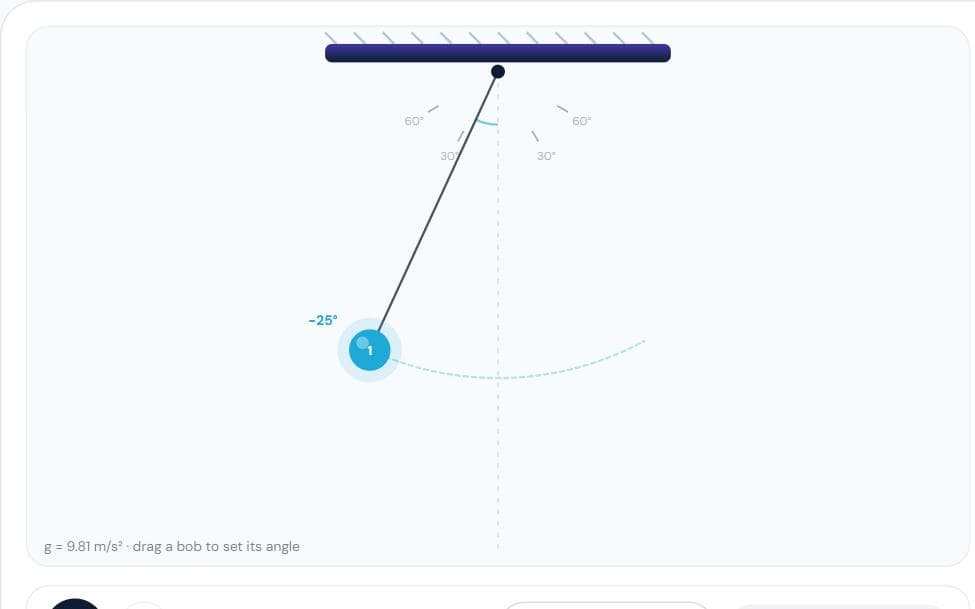
  1. 1Drag the bob to an angle and let go.
  2. 2Change length, mass, gravity and friction.
  3. 3Use the period timer or the stopwatch.
  4. 4Add a second pendulum to compare.

What to notice

  • T = 2π√(L/g) — the period does not depend on the mass.
  • For small angles the period barely depends on amplitude; above ~30° it grows.
  • Four times the length → twice the period.
  • Energy swaps between kinetic and potential every quarter swing.

For teachers

A ready-made teaching kit comes with this lab

  • Lesson plan

    22 min, 4 steps

  • Ask the class

    4 questions with answers

  • Quick quiz

    6 questions, printable

  • Key formulas

    3 formulas

About the Pendulum Lab simulation

A simple pendulum is a mass on a light string that swings back and forth under gravity. For small swings its period depends only on the length of the string and on g — not on the mass and, very nearly, not on how far you pull it back. That is why pendulums kept time for three centuries.

This pendulum simulation lets you change the length, mass and angle, swing it on Earth, the Moon, Mars, Jupiter or a mystery Planet X, add friction, time ten swings with a stopwatch and compare two pendulums side by side. Pull it out past about 30° and you can see the small-angle formula start to fail. It matches the Oscillations chapter of Class 11 and the simple pendulum experiment in the practical exam.

Also covers: simple pendulum, time period, small angle, acceleration due to gravity, planet x, energy.
Frequently asked questions

Does the mass of the bob change the period of a pendulum?

No. Both the restoring force and the inertia are proportional to the mass, so it cancels out: T = 2π√(L/g) has no m in it.

What happens to the period if the length is made four times as long?

It doubles, because T is proportional to √L.

Why is a pendulum slower on the Moon?

g on the Moon is about 1.62 m/s², roughly one-sixth of Earth's, so T = 2π√(L/g) is about √6 ≈ 2.45 times longer.

When does T = 2π√(L/g) stop being accurate?

For large amplitudes. At 30° the true period is about 1.7% longer; at 70°, about 10% longer. The formula assumes sin θ ≈ θ.