Skip to content
Light & Optics · Physics

Polarisation of Light Simulation

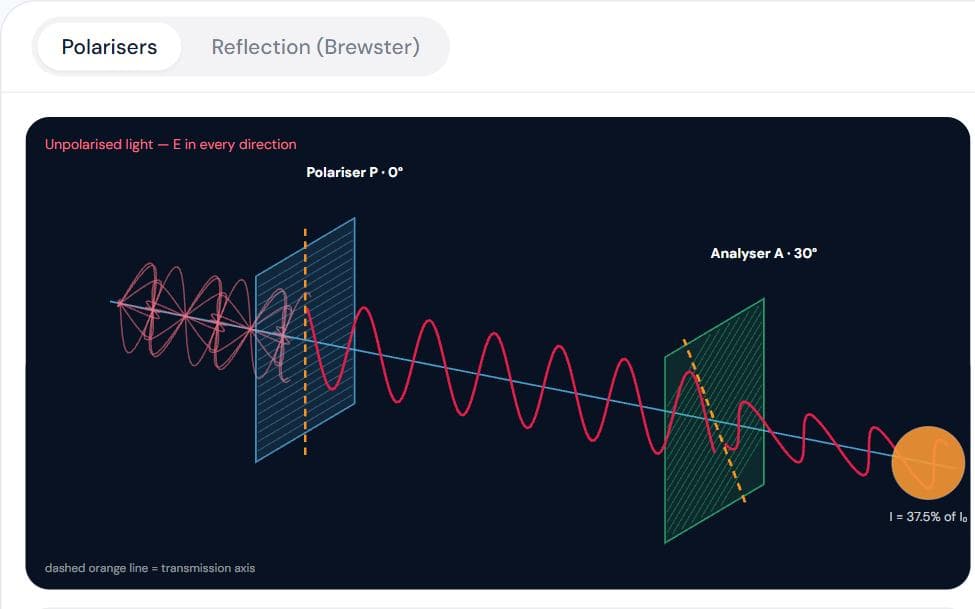
Send unpolarised light through a polariser and an analyser and watch the electric field in 3D. Turn the analyser to see Malus's law, I = I₀cos²θ, add a third plate between crossed polarisers, and find Brewster's angle on reflection.

Interactive virtual lab · no download · works on phones and laptops

Chapter
Wave Optics
For
Class 12 · JEE · NEET
Time
~12 min

Polarisation of Light is a Pro simulation

Pro opens all 125 virtual labs — 483 simulations with guides and quizzes.

How to use it

  1. 1Turn the polariser and the analyser with their sliders (or the presets).
  2. 2Switch on plate B to put a third polariser between them.
  3. 3Watch the intensity bars and the I–θ graph as you turn the analyser.
  4. 4Reflection tab: change the angle of incidence and find where the p-polarised reflection vanishes.

What to notice

  • A polariser passes only the part of E along its transmission axis: unpolarised light loses half its intensity.
  • Through a second polariser at θ, I = I₀cos²θ — crossed polarisers (90°) pass nothing.
  • A third plate at 45° between crossed polarisers lets light through again: I₀/8.
  • Reflected light is fully polarised at Brewster's angle, where tan θB = n and the reflected and refracted rays are at 90°.

For teachers

A ready-made teaching kit comes with this lab

  • Lesson plan

    21 min, 4 steps

  • Ask the class

    4 questions with answers

  • Quick quiz

    7 questions, printable

  • Key formulas

    3 formulas

About the Polarisation of Light simulation

Light is a transverse wave: its electric field vibrates at right angles to the direction it travels. In ordinary (unpolarised) light that vibration points every which way; a polariser lets through only the part along its transmission axis. A second polariser, the analyser, then passes I₀cos²θ of what reaches it — Malus's law. Crossed polarisers pass nothing.

This polarisation simulation draws the light and its electric field in 3D as it passes a polariser, an optional middle plate and an analyser, with an intensity graph as you turn them. A reflection screen shows Brewster's law: at tan θ = n the reflected light is completely polarised. It covers Wave Optics in Class 12 and the Malus's law and Brewster's angle questions in JEE and NEET.

Also covers: polarization, polariser, polarizer, analyser, Malus's law, Brewster's angle, polaroid, wire grid, transverse wave.
Frequently asked questions

What fraction of unpolarised light passes through a polariser?

Half: the average of cos²θ over all directions is ½.

How can crossed polarisers let light through?

Put a third polariser between them at 45°: I₀/2 × cos²45° × cos²45° = I₀/8 gets through.

What is Brewster's angle for glass?

tan θ = 1.5, so about 56.3°. The reflected and refracted rays are then at 90° to each other.

Can sound be polarised?

No. Polarisation needs a transverse wave; sound in air is longitudinal.